
Free form · Alberta
Alberta rental application form, with the privacy notice built in.
A four-page fillable PDF (and Word file) for Alberta landlords. It opens with the notice of purpose Alberta's privacy law requires, asks for reasonable proof the applicant can pay the rent, and lets them choose between a credit check and handing you their own report.
Also in Word (.docx)See a filled-in example
Fillable PDF · 4 pages · No email or sign-up · Reviewed September 2026
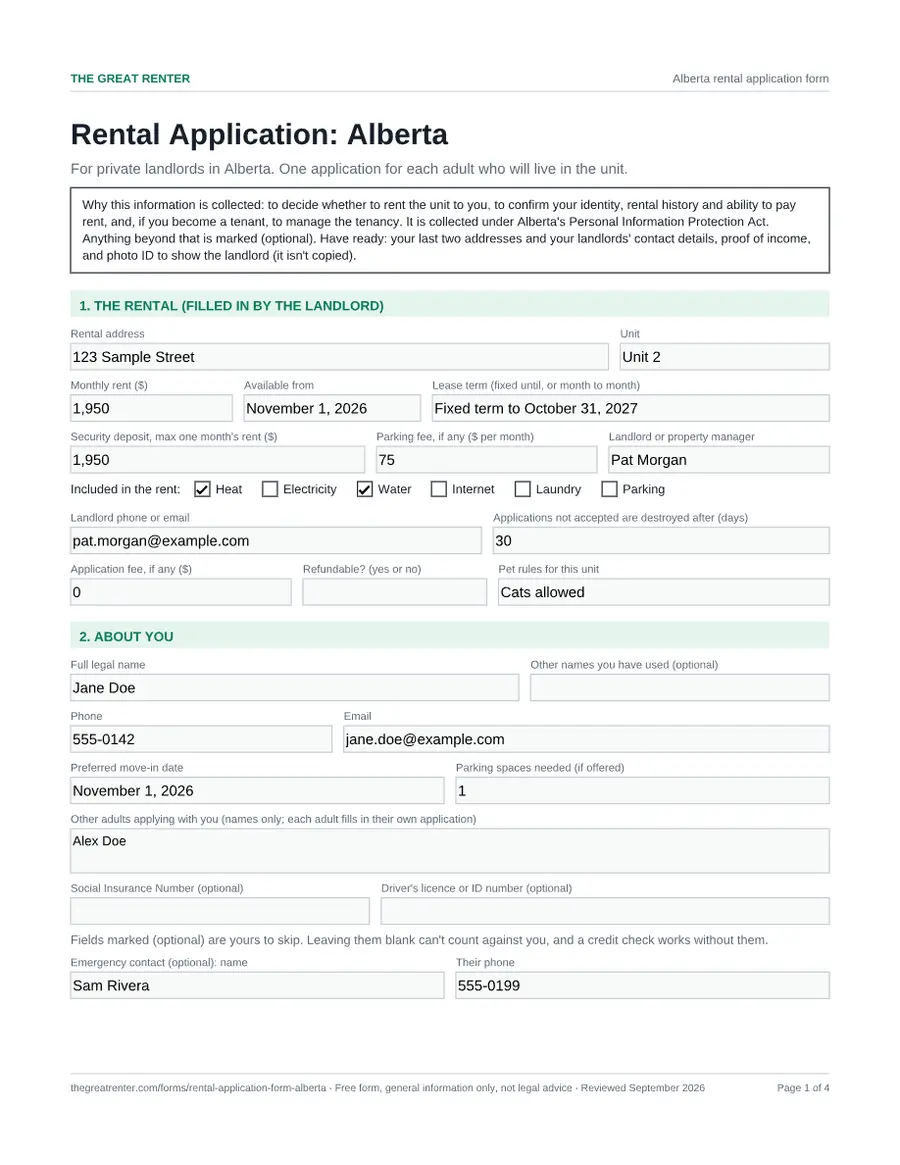 Filled-in example
Section by section
What's on the form, and why it's there
Why we collect this
A short notice at the top of page 1, before any questions.
The rental
Your offer: address, rent, lease term, security deposit, parking fee, what's included, pet rules, and any application fee.
Alberta doesn't ban application fees, but the government's handbook says a fee should reflect your actual costs, should be disclosed when you take the application, and, if refundable, counts toward the one-month deposit limit.10 The form has a line for it so the applicant sees it in writing, next to the deposit line and its one-month cap.3,4About you and rental history
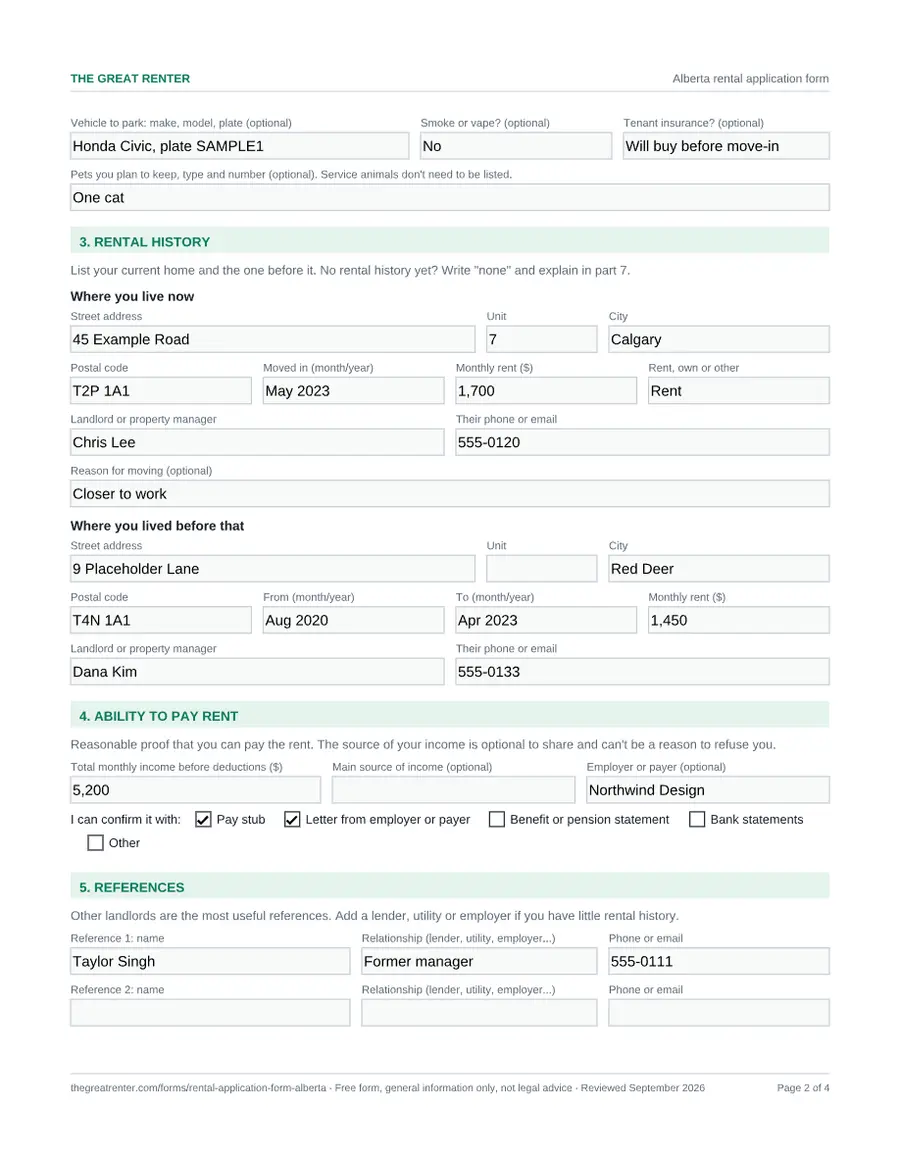
Name, contact details, other adult applicants, optional SIN, ID number, emergency contact, vehicle and pets, and the current and previous landlords.
Landlords may collect only what they reasonably need to decide whether to rent, and references from other landlords and contact details are on the commissioner's list.1Ability to pay rent
Total monthly income and how it can be confirmed; the employer is optional.
References
Other landlords first, then a lender, utility or employer.
Collect reference information only with the applicant's consent, and keep what's shared to suitability as a tenant (complaints, damage, rent payment), not personal characteristics. It's reasonable to decline an applicant who won't give references.1Guarantor (optional)
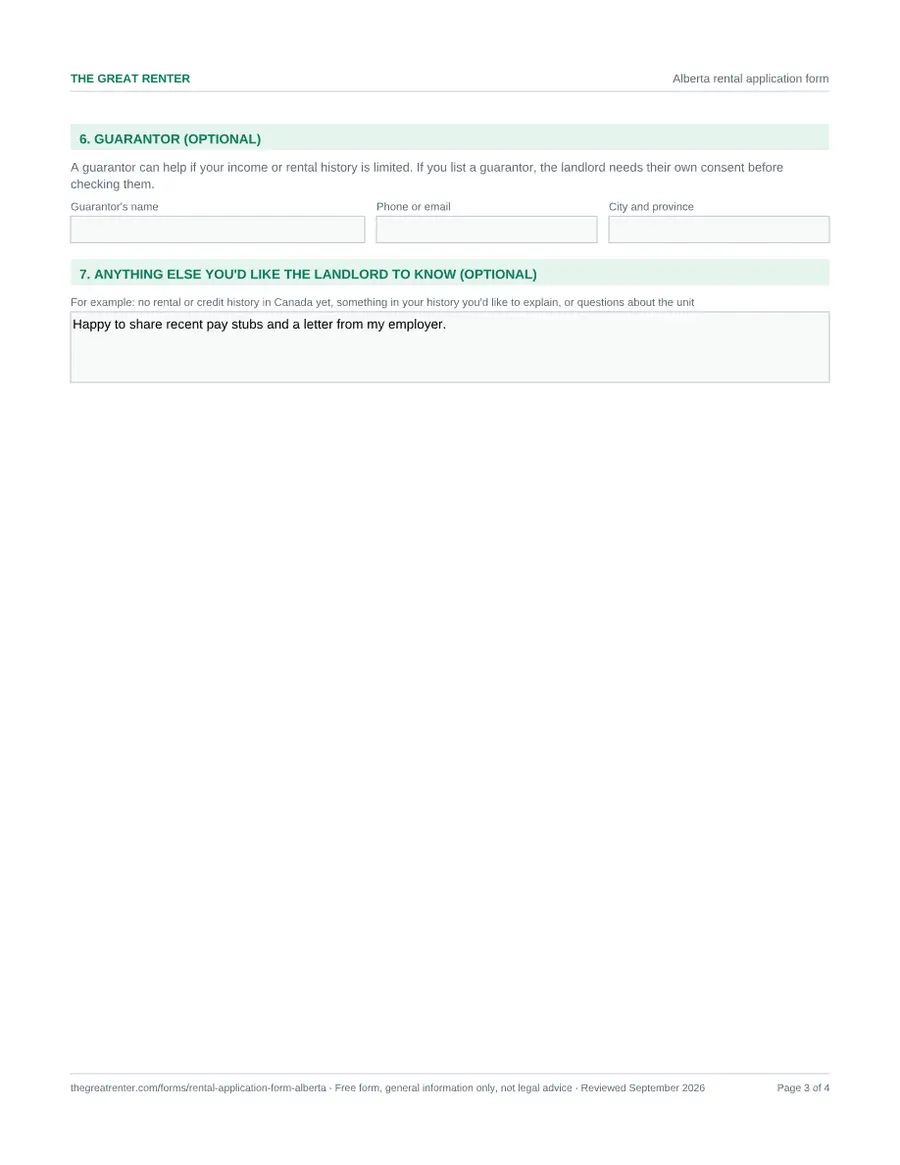
A guarantor's name, contact and city, if the applicant wants to offer one.
A guarantor can help an applicant with limited income or history. The guarantor's information is theirs, so checking it needs their own consent under PIPA.1Consent and signature
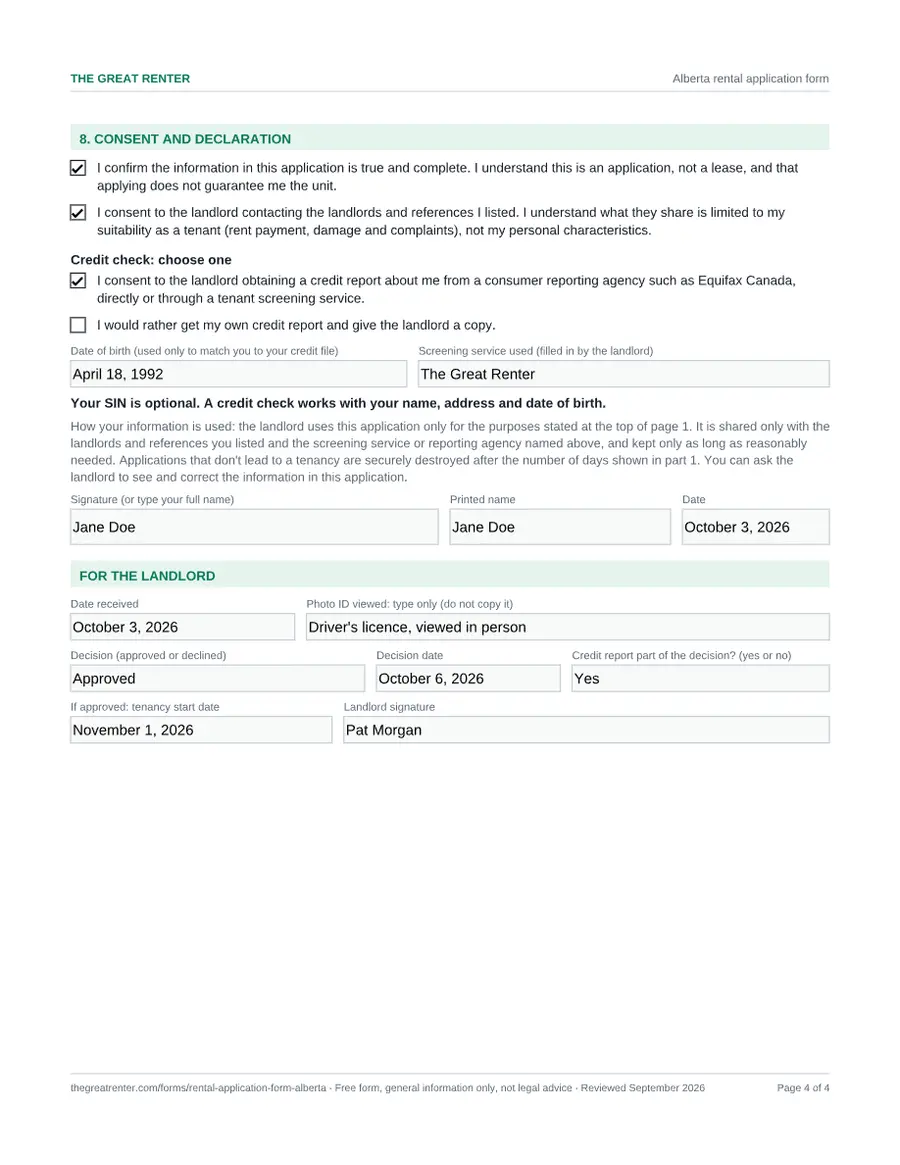
Consent to reference checks, a choice between a credit check and the applicant's own report, date of birth, and a signature.
You need consent under both the Consumer Protection Act and PIPA before you order a credit report, and the commissioner notes the applicant can instead get their own report and give you a copy.1 The form offers both.
Filled-in example
See every page, filled in
Sensitive questions
Sensitive questions: optional, or not asked
Social Insurance Number
OptionalThe commissioner says to avoid it: a full name and date of birth produce a credit report in nearly all cases, and a tenancy can't be refused because an applicant won't give their SIN.1 So it's optional, and a blank can't count against anyone.
Licence or ID number
OptionalOptional, and no photocopy. Looking at ID to confirm identity is fine; copying it may not be: the commissioner's example is a driver's licence copy, which also records eye colour, height and weight.1
Main source of income
OptionalSource of income is a protected ground in Alberta tenancies, so the type of income is optional and can't be a reason to refuse: the Human Rights Commission's example is a landlord turning someone down because they receive AISH.7,9
Ages and family details
Not askedKept off. Age has been a protected ground in Alberta tenancies since January 1, 2018, and family status is protected too, so asking gives an applicant grounds to complain even when it's optional.7,8
Never a reason to refuse an applicant in Alberta
- Race
- Religious beliefs
- Colour
- Gender
- Gender identity
- Gender expression
- Physical disability
- Mental disability
- Age
- Ancestry
- Place of origin
- Marital status
- Source of income
- Family status
- Sexual orientation
Alberta rules
Six rules that apply around the application
Deposit: one month, held in trust
A security deposit can't exceed one month's rent. It goes into an interest-bearing trust account in Alberta within two banking days, with interest paid yearly (the 2026 rate is 0%).3,4,5
Application fees: cost only
Allowed, but the handbook says a fee should cover actual costs, be disclosed up front, and may be unenforceable if it goes beyond cost recovery. A refundable fee counts toward the deposit cap.10
Inspections are mandatory
Inspect with the tenant within a week before or after move-in and move-out, give them the report, and keep it for three years. Without it, you can't deduct for damage.3,6
Age is protected
You can't turn someone down for being too young or too old, or for having children, unless the building qualifies as seniors-only housing.7,8
Keep files only as long as needed
PIPA lets you keep personal information only as long as reasonably needed. The commissioner says there's no need to keep credit reports or applications once a tenant moves out.1
Disputes go to the RTDRS
The Residential Tenancy Dispute Resolution Service hears landlord and tenant disputes. Since April 1, 2026 filing costs $75 for claims up to $7,500 and $150 above that.11
Reviewing an application
What to check, and what isn't a red flag
Worth a closer look
- A name, date of birth or address that doesn't match the photo ID you viewed.
- A current landlord you can't reach, or whose number you can't find anywhere but the application.
- Gaps in the rental history the applicant hasn't explained.
- Income figures that don't match the pay stub or the employer contact you called.
- Pressure to skip steps: signing today, moving in before checks, or paying in cash with no receipt.
Not a red flag
- A blank SIN: a tenancy can't be refused because an applicant won't give it.1
- Income from AISH or another source: source of income is protected in Alberta tenancies.7,9
- Age, or having children: age (18 and over) and family status are protected, outside seniors-only housing.7,8
- Offering their own credit report instead of a check: the commissioner says that's an acceptable alternative.1
After it comes back
From application to move-in
- 1
Check the application is complete
One signed application per adult, with the credit check choice made. If they chose to supply their own report, ask for it now. Screen the applicants you're considering
With The Great Renter the applicant confirms their own details and consent in a secure link, and you get the Equifax report with ID verification. See a sample report.- 3
Call the landlords listed
Ask about rent payment, damage and complaints, not personal characteristics.1 Our reference request includes the applicant's written consent. - 4
- 5
Destroy what you don't need
Securely destroy applications from people you didn't rent to once you no longer need them, as your form told them you would.1
Got an application back? Screen this applicant.
Send the applicant a secure link. They confirm their own details and consent, and you get their Equifax credit report and ID verification in one report. No account, no subscription.
See what the report looks likeGot questions?
Alberta rental applications, answered
What can a landlord ask on an Alberta rental application?
Under Alberta's Personal Information Protection Act, only what's reasonably needed to decide whether to rent: reasonable proof the applicant can pay the rent, references from other landlords, and contact details, with notice of why it's collected. The privacy commissioner says to avoid the SIN and not to photocopy ID.
Is there a Word version of the Alberta rental application?
Yes. It comes as a fillable PDF and as a Word (.docx) file with the same wording. Use the Word version if you want to type in your unit details once and reuse it.
Is this Alberta rental application form free?
Yes. It's a free, fillable PDF with no sign-up, written around Alberta's Personal Information Protection Act and the privacy commissioner's guidance for landlords.
Can Alberta landlords charge an application fee?
Alberta doesn't prohibit them. The government's Residential Tenancies Act handbook says a fee should reflect the landlord's actual costs, should be disclosed when the application is taken, may be unenforceable if it goes beyond cost recovery, and, if refundable, counts toward the one-month security deposit limit.
Can I ask for a SIN on an Alberta rental application?
Only as an optional question. The Office of the Information and Privacy Commissioner of Alberta says landlords should avoid collecting it, because a full name and date of birth produce a credit report in nearly all cases, and a landlord can't deny a tenancy because the applicant refuses to give a SIN. This form marks it optional.
Do I need consent for a credit check in Alberta?
Yes. The commissioner says a landlord must get the applicant's consent before ordering a credit report, under both the Consumer Protection Act and PIPA. The applicant can also get their own report and give you a copy, which this form lets them choose.
What's the maximum security deposit in Alberta?
One month's rent. It must be placed in an interest-bearing trust account at a financial institution in Alberta within two banking days, and interest is paid yearly at the provincial rate, which is 0% for 2026.
Keep reading
- Tenant screening in AlbertaThe RTDRS, consent rules and what an Alberta landlord can check.
- What a landlord can ask forBank statements, SIN, credit checks and deposits: what Alberta allows, next to four other provinces.
- Tenant credit check consent formA standalone written consent, if you collect it separately.
- What a tenant credit check showsScore bands, the four parts of an Equifax report, and common misreads.
Sources, checked September 2026
- 1.Office of the Information and Privacy Commissioner of Alberta, Guidance for landlords and tenants (PDF, December 2023)
- 2.OIPC Alberta, Guidance for landlords and tenants
- 3.Alberta Residential Tenancies Act (ss. 19, 43 to 46)
- 4.Government of Alberta, Starting a tenancy
- 5.Government of Alberta, Annual security deposit interest rate
- 6.Service Alberta, Inspection reports (fact sheet)
- 7.Alberta Human Rights Act (s. 5)
- 8.Alberta Human Rights Commission, Age discrimination in housing
- 9.Alberta Human Rights Commission, Protected grounds
- 10.Government of Alberta, Residential Tenancies Act handbook (June 2025)
- 11.Government of Alberta, Residential Tenancy Dispute Resolution Service
This form and page are general information, not legal advice. Laws change; check the linked sources, and talk to a lawyer or your province's tenancy office about your situation.