
Free form · Manitoba
Manitoba rental application form, with the consent Manitoba requires.
A four-page fillable PDF (and Word file) for Manitoba landlords. Page 4 carries the consent the Personal Investigations Act requires before you call a reference or order a credit report, laid out the way the regulation asks.
Also in Word (.docx)See a filled-in example
Fillable PDF · 4 pages · No email or sign-up · Reviewed September 2026
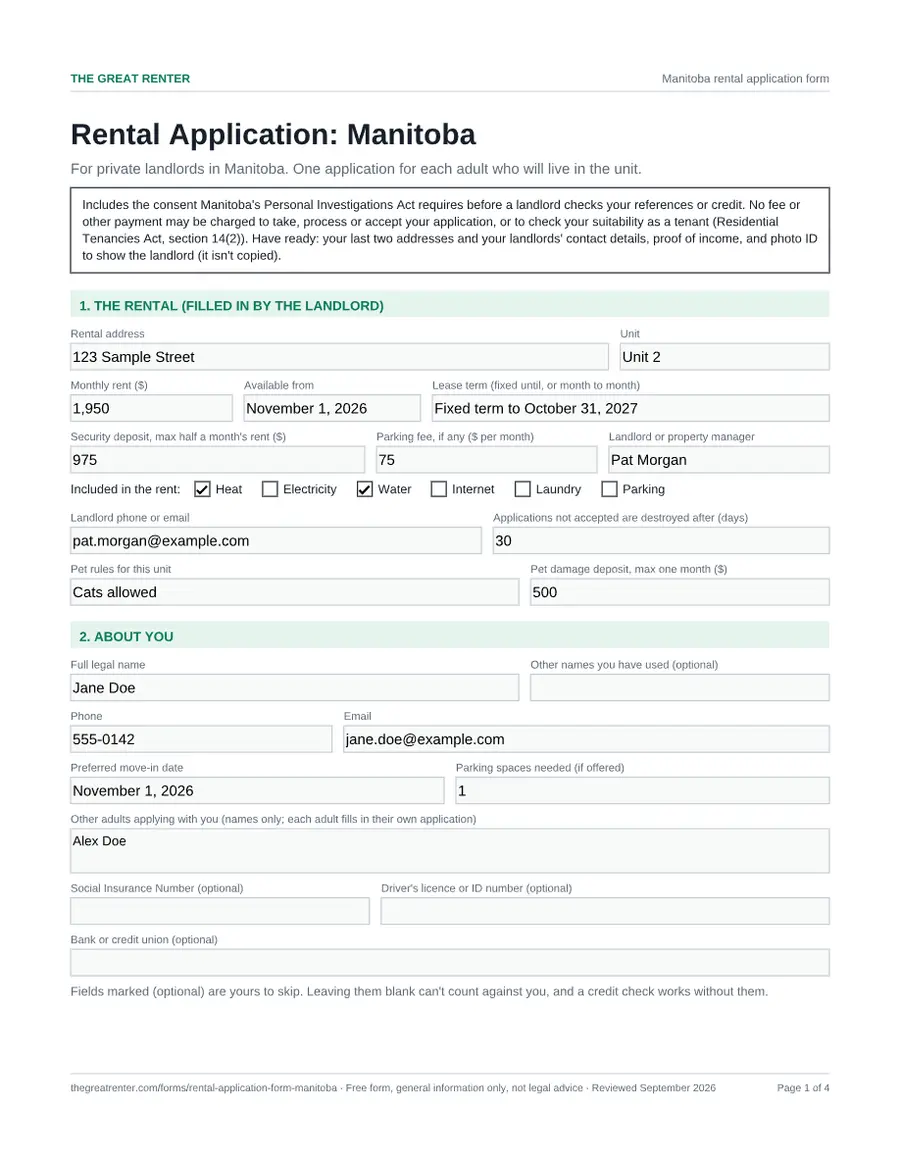 Filled-in example
Only in Manitoba
What a “personal investigation” means for you
It covers more than a credit check
The Act defines a personal investigation as any inquiry that gets information about a person from someone other than that person, with a view to a tenancy, and treats the landlord as the “user”.4 Calling a previous landlord counts, and so does ordering a credit report. Both need consent first.
What the consent has to say
Before getting consent, tell the applicant the purpose, what information you'll collect, where from, who else will see it, when the consent takes effect and when it expires.5 A consent in the application can run for the whole tenancy.4 Page 4 of this form covers each point, in the 10-point type the regulation asks for.
Section by section
What's on the form, and why it's there
The rental and about you
Your offer (rent, lease term, deposits, what's included), then the applicant's name, contact details, other adults and optional details.
Rental history
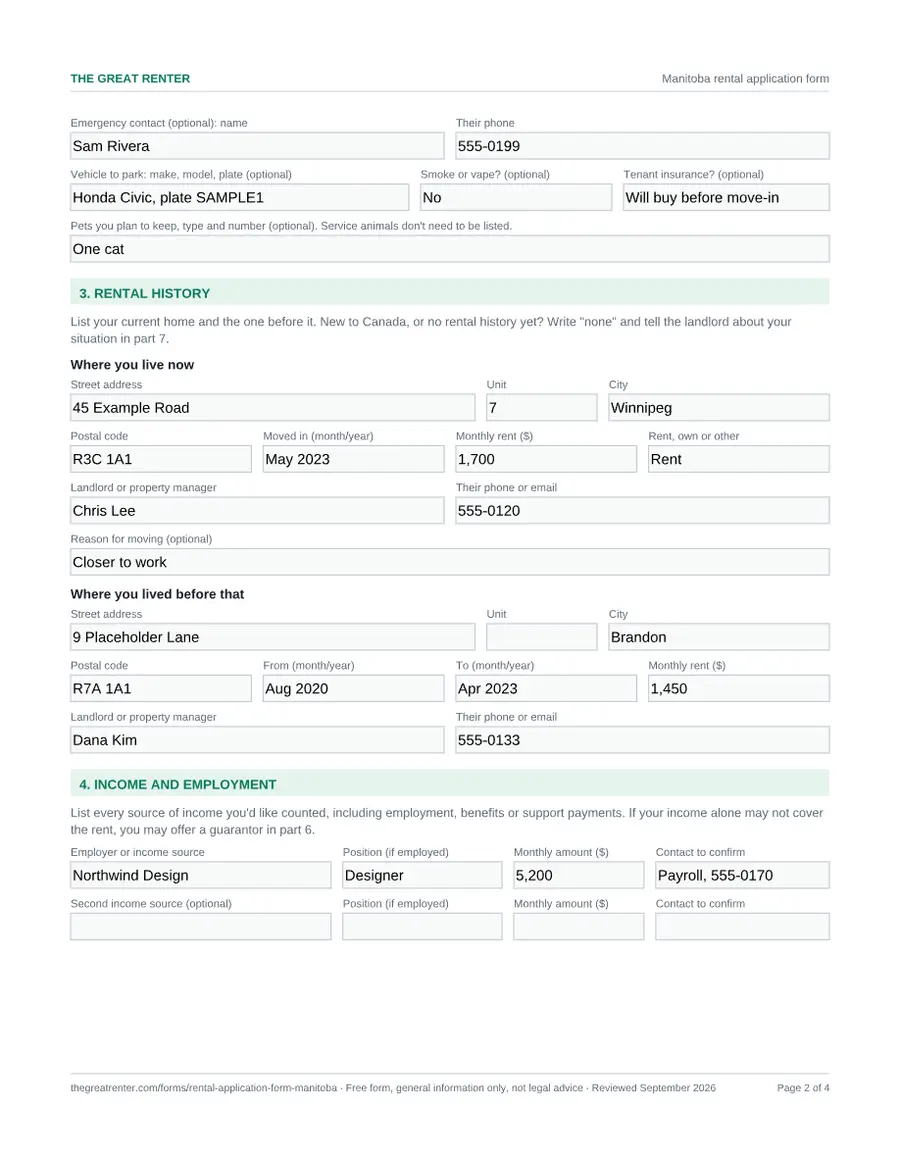
Current and previous address, dates, rent and landlords, with a note for newcomers.
The Human Rights Commission cautions that requiring references can unreasonably exclude newcomers, so the form invites anyone without a Canadian rental history to explain instead of leaving a gap.11Income and employment
Up to two income sources with position, monthly amount and a contact, plus an optional guarantor.
The Commission says landlords may ask about employer, position and salary, and that if you use a rent-to-income ratio, applicants should be able to list all their income sources and offer a guarantor. Refusing someone only because they receive disability benefits may be discrimination.11References
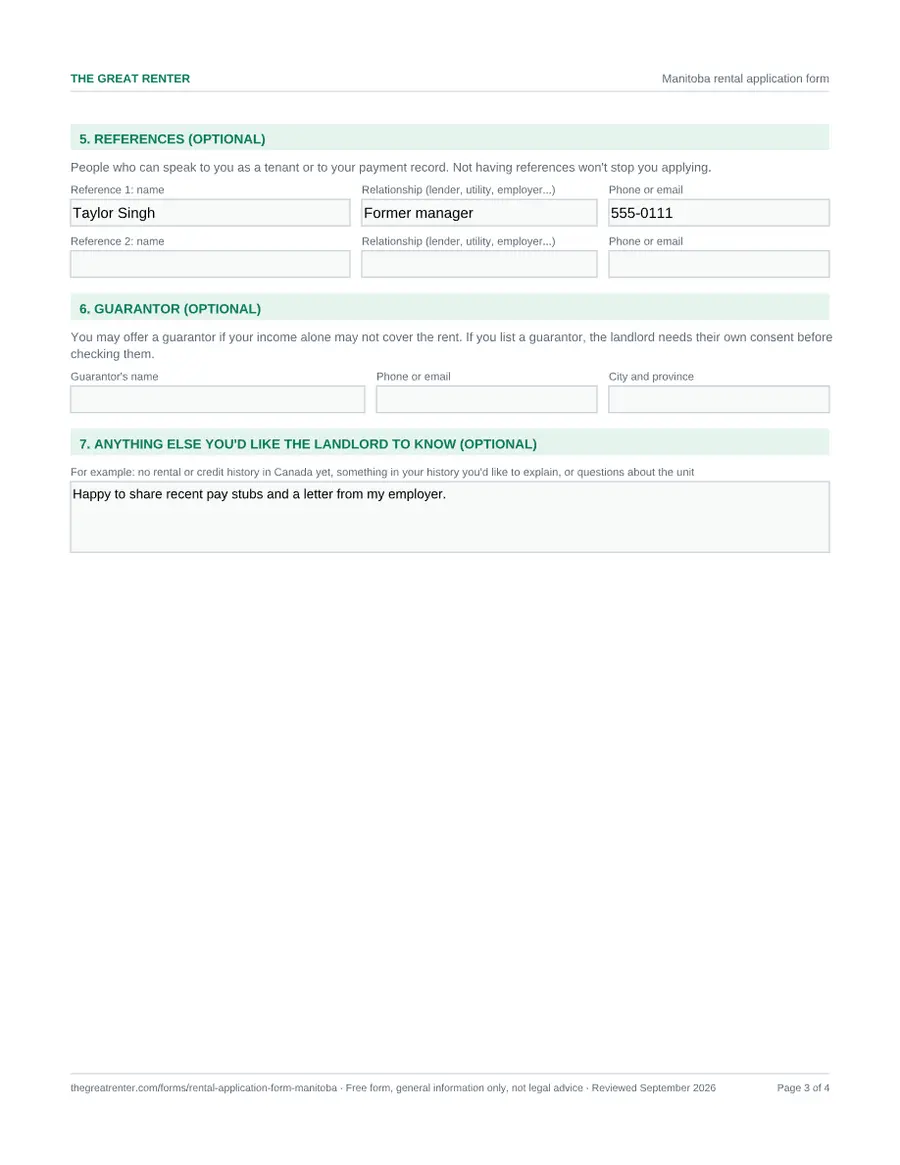
Optional: up to two people who can speak to the applicant as a tenant.
Checking references is part of a personal investigation, so it's covered by the consent on page 4.4Guarantor (optional)
A guarantor's name, contact and city, if the applicant wants to offer one.
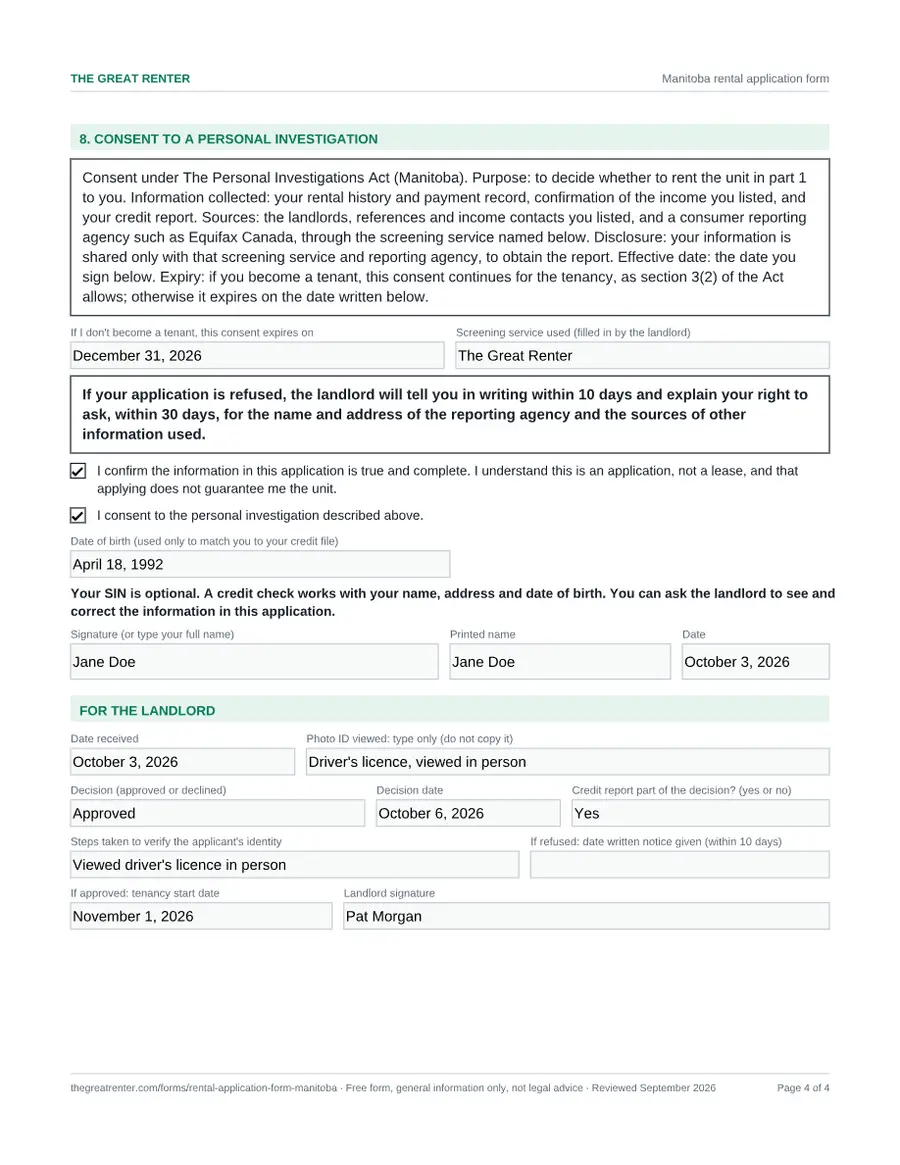
Consent to a personal investigation
A 10-point consent above the signature covering purpose, information, sources, disclosure, effective date and expiry.
The Personal Investigations Act bars checking an applicant with anyone other than the applicant (references, a credit bureau) without their consent, and lets that consent sit in the tenancy application.4 The regulation says what the consent must state, and that a written consent be clear, in at least 10-point type, and above the signature.5 The Residential Tenancies Branch advises getting it in writing.6Refusal notice and landlord box
The 10-day written refusal notice, and a box to record how you verified identity.
Filled-in example
See every page, filled in
Sensitive questions
Sensitive questions: optional, or not asked
Social Insurance Number
OptionalThe federal Privacy Commissioner, whose law covers Manitoba landlords, says a landlord doesn't need a SIN; a credit check needs a name, address and date of birth.9,7 So it's optional, and a blank can't count against anyone.
Licence or ID number
OptionalOptional. The Commissioner says landlords likely don't need to take a copy of a driver's licence or pay stubs: look, confirm, and record what you checked, as the Personal Investigations Regulation asks.9,5
Bank or credit union
OptionalOptional. A credit check needs only a name, address and date of birth,9 but an applicant with a thin credit file may want to show where they bank.
Ages or family details
Not askedKept off. Age and marital or family status are protected characteristics under Manitoba's Human Rights Code, so asking invites a complaint even when the question is optional.10
Never a reason to refuse an applicant in Manitoba
- Ancestry, including colour and perceived race
- Nationality or national origin
- Ethnic background
- Religion or creed
- Age
- Sex, including pregnancy
- Gender identity
- Gender expression
- Sexual orientation
- Marital or family status
- Source of income
- Political belief
- Physical or mental disability
- Social disadvantage
Manitoba rules
Six rules that apply before the lease
No application or screening fees
Section 14(2) of the Residential Tenancies Act, in force since May 30, 2023, bars any payment for taking or processing an application or investigating an applicant.1,2
Security deposit: half a month
At most half of the first month's rent, not payable until the tenancy agreement is made. Say before signing that you require one, and give a written receipt.1,3
Pet deposit: up to a full month
A pet damage deposit can be up to one month's rent, one per tenancy however many pets, and none for a service animal.1,3
Refused? Write within 10 days
After a refusal, the Personal Investigations Act requires written notice within 10 days, and the applicant can ask within 30 days for the reporting agency's name and address and your other sources.4
Reviewing an application
What to check, and what isn't a red flag
Worth a closer look
- A name, date of birth or address that doesn't match the photo ID you viewed.
- A current landlord you can't reach, or whose number you can't find anywhere but the application.
- Gaps in the rental history the applicant hasn't explained.
- Income figures that don't match the pay stub or the employer contact you called.
- Pressure to skip steps: signing today, moving in before checks, or paying in cash with no receipt.
Not a red flag
- No references, as a newcomer: the Human Rights Commission says requiring references can unreasonably exclude newcomers.11
- Income from disability benefits or another source: refusing someone only because they receive disability benefits may be discrimination, and source of income is protected.11,10
- A period of homelessness or chronic low income: social disadvantage is a protected characteristic in Manitoba.10
- A blank SIN: a credit check needs only a name, address and date of birth.9
After it comes back
From application to signed agreement
- 1
Check the consent is complete
Page 4 should be signed with an expiry date filled in. Without that consent, don't contact references or order a credit report.4 Screen the applicants you're considering
The Great Renter collects the applicant's consent again in its own secure flow before the check runs, and returns Equifax credit and ID verification in one report. See what the credit report includes.- 3
Call references and verify identity
Record the steps you took to confirm who the applicant is, as the regulation requires.5 Our reference request carries the applicant's signed consent. - 4
Send refusals in writing
Everyone you turn down gets written notice within 10 days of your decision.4 - 5
Sign Form 1 and take the deposit
Use the standard residential tenancy agreement, give the tenant a signed copy within 21 days, and issue a receipt for the deposit.1,3
Got an application back? Screen this applicant.
Send the applicant a secure link. They confirm their own details and consent, and you get their Equifax credit report and ID verification in one report. No account, no subscription.
See what the report looks likeGot questions?
Manitoba rental applications, answered
Can a Manitoba landlord ask for a SIN?
Only as an optional question. The federal Privacy Commissioner, whose law covers Manitoba landlords, says a landlord doesn't need a SIN because a credit check works with a name, address and date of birth. This form marks it optional.
Is there a Word version of the Manitoba rental application?
Yes. It comes as a fillable PDF and as a Word (.docx) file with the same wording. Use the Word version if you want to type in your unit details once and reuse it.
Is this Manitoba rental application form free?
Yes. It's a free, fillable PDF with no sign-up. It includes the consent wording Manitoba's Personal Investigations Act requires before you check references or credit.
Can a Manitoba landlord charge an application fee?
No. Since May 30, 2023, section 14(2) of the Residential Tenancies Act bars a landlord from requiring or accepting any payment for taking, processing or accepting a rental application, or for investigating an applicant's suitability as a tenant.
Do I need written consent for a credit check in Manitoba?
You need the applicant's consent under the Personal Investigations Act before checking them with anyone else, including a credit bureau. The regulation allows written, electronic or recorded oral consent, and says written consent must be clear, in at least 10-point type and above the signature. The Residential Tenancies Branch advises getting written permission.
What do I have to do if I turn an applicant down?
Tell them in writing within 10 days of the refusal, including their right to ask for information. If they ask within 30 days, give them the name and address of the reporting agency and the sources of other information you used.
How much can I take as a deposit in Manitoba?
A security deposit of up to half of the first month's rent, payable only once the tenancy agreement is made, and a pet damage deposit of up to one month's rent, with none for a service animal.
Keep reading
- Tenant credit check consent formA standalone consent that also carries the Manitoba notice.
- What a landlord can ask forBank statements, SIN, credit checks and deposits: what Manitoba allows, next to four other provinces.
- What a tenant credit check showsThe four parts of an Equifax report, and how to read the score.
- See a sample screening reportThe full report a landlord receives, on two fictional applicants.
Sources, checked September 2026
- 1.Manitoba Residential Tenancies Act, C.C.S.M. c. R119 (ss. 7, 8, 14, 29, 29.1)
- 2.The Residential Tenancies Amendment Act, S.M. 2023, c. 43 (application fee ban)
- 3.Residential Tenancies Branch, Deposits (fact sheet)
- 4.The Personal Investigations Act, C.C.S.M. c. P34
- 5.Personal Investigations Regulation, Man. Reg. 392/87 R
- 6.Residential Tenancies Branch, Before you rent: a landlord's guide
- 7.Office of the Privacy Commissioner of Canada, Summary of privacy laws in Canada
- 8.Office of the Privacy Commissioner of Canada, Interpretation bulletin: commercial activity
- 9.Office of the Privacy Commissioner of Canada, Privacy in the landlord and tenant relationship
- 10.The Human Rights Code (Manitoba), C.C.S.M. c. H175 (ss. 9, 16)
- 11.Manitoba Human Rights Commission, Guideline on housing
- 12.Residential Tenancies Branch, Landlord forms (Form 1, standard residential tenancy agreement)
This form and page are general information, not legal advice. Laws change; check the linked sources, and talk to a lawyer or your province's tenancy office about your situation.