
Free form · British Columbia
BC rental application form, written to the privacy rules.
A four-page fillable PDF (and Word file) for landlords renting in British Columbia. It collects what the province's privacy commissioner says a landlord reasonably needs, makes the SIN optional, and leaves off what BC says not to ask: bank details and ID numbers.
Also in Word (.docx)See a filled-in example
Fillable PDF · 4 pages · No email or sign-up · Reviewed September 2026
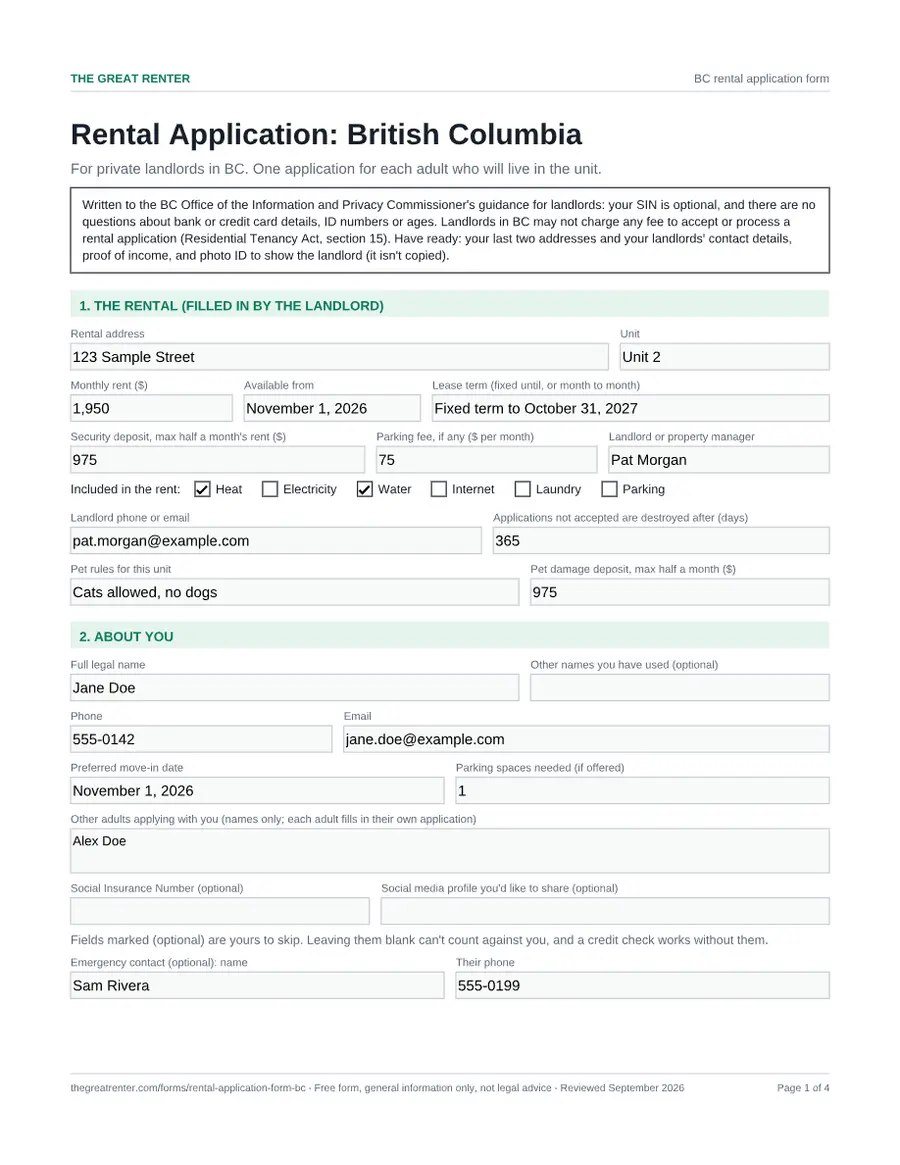 Filled-in example
Section by section
What's on the form, and why it's there
The rental
Your offer: address, rent, lease term, security and pet deposits, parking fee, what's included, pet rules, and how long you keep applications.
About you
Name, contact details, move-in date and other adult applicants, then optional SIN, social media, emergency contact, vehicle, smoking, tenant insurance and pets.
Rental history
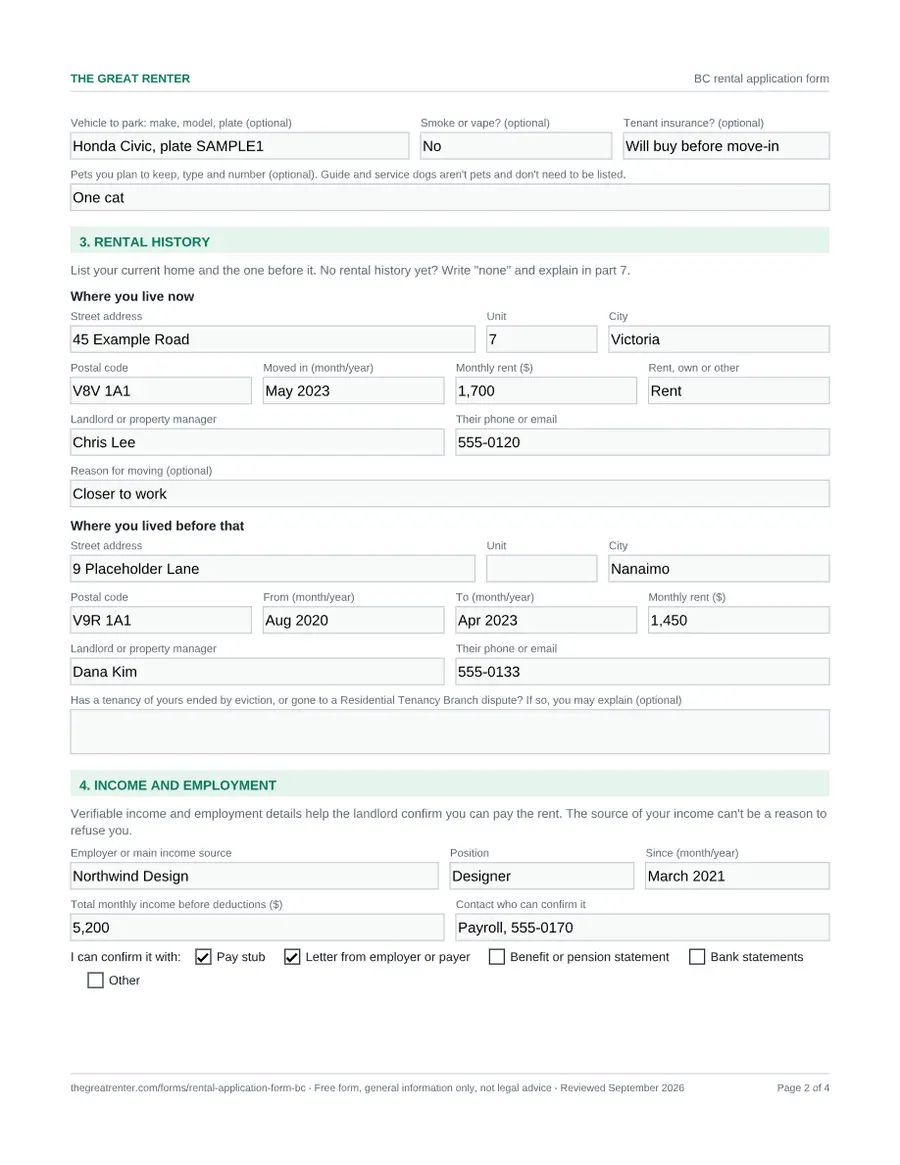
Current and previous address, dates, rent, landlords' contacts, and an optional note on past evictions or disputes.
The commissioner's guidance says asking where and for how long someone has rented, and about past evictions or tenancy disputes, is reasonable.3Income and employment
Employer or income source, position, monthly income, and how it can be confirmed.
References
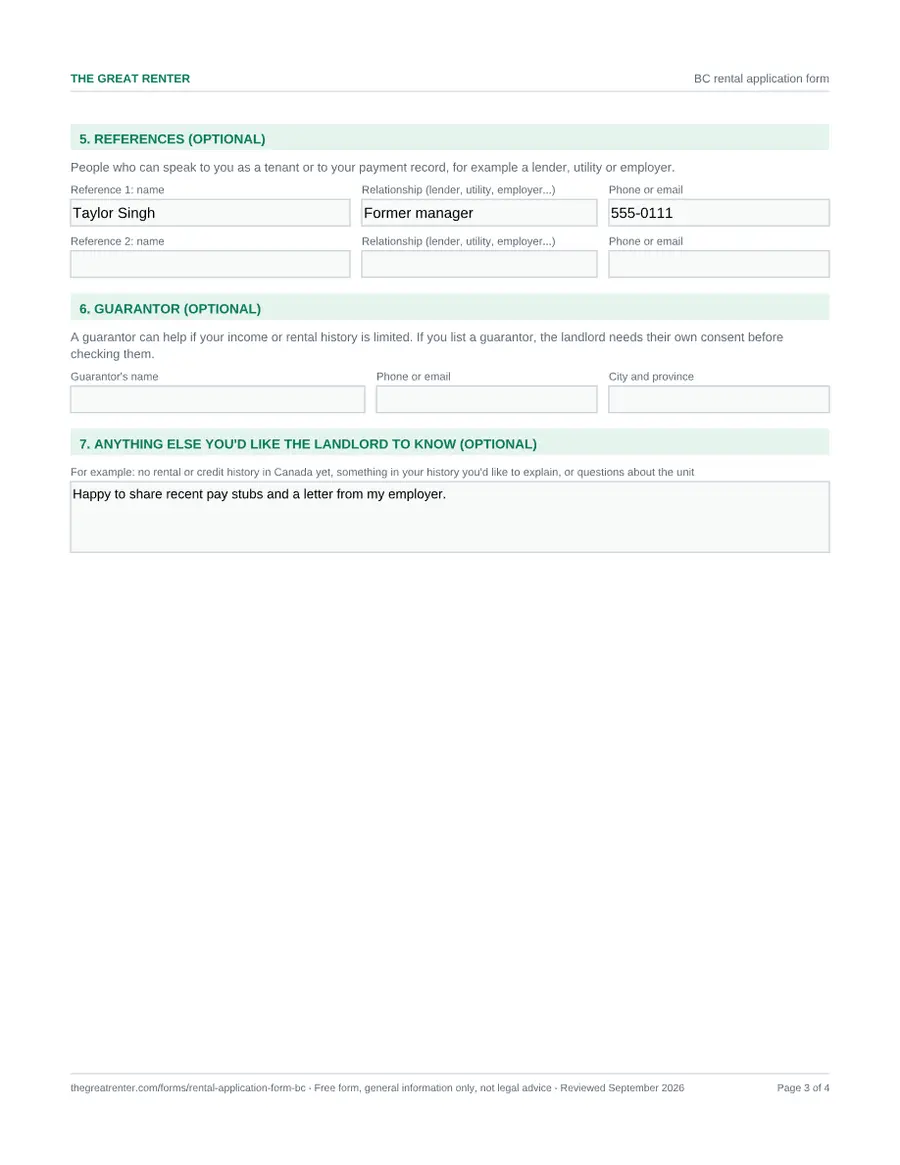
Up to two people who can speak to the applicant as a tenant or to their payment record.
References are allowed with the applicant's consent, and what landlords share about a tenant should be limited to their suitability as a tenant: complaints, damage and rent payment history.3Guarantor (optional)
A guarantor's name, contact and city, if the applicant wants to offer one.
A guarantor can help an applicant with limited income or rental history. The guarantor is a separate person, so checking them needs their own consent, just like the applicant's.3Consent and signature
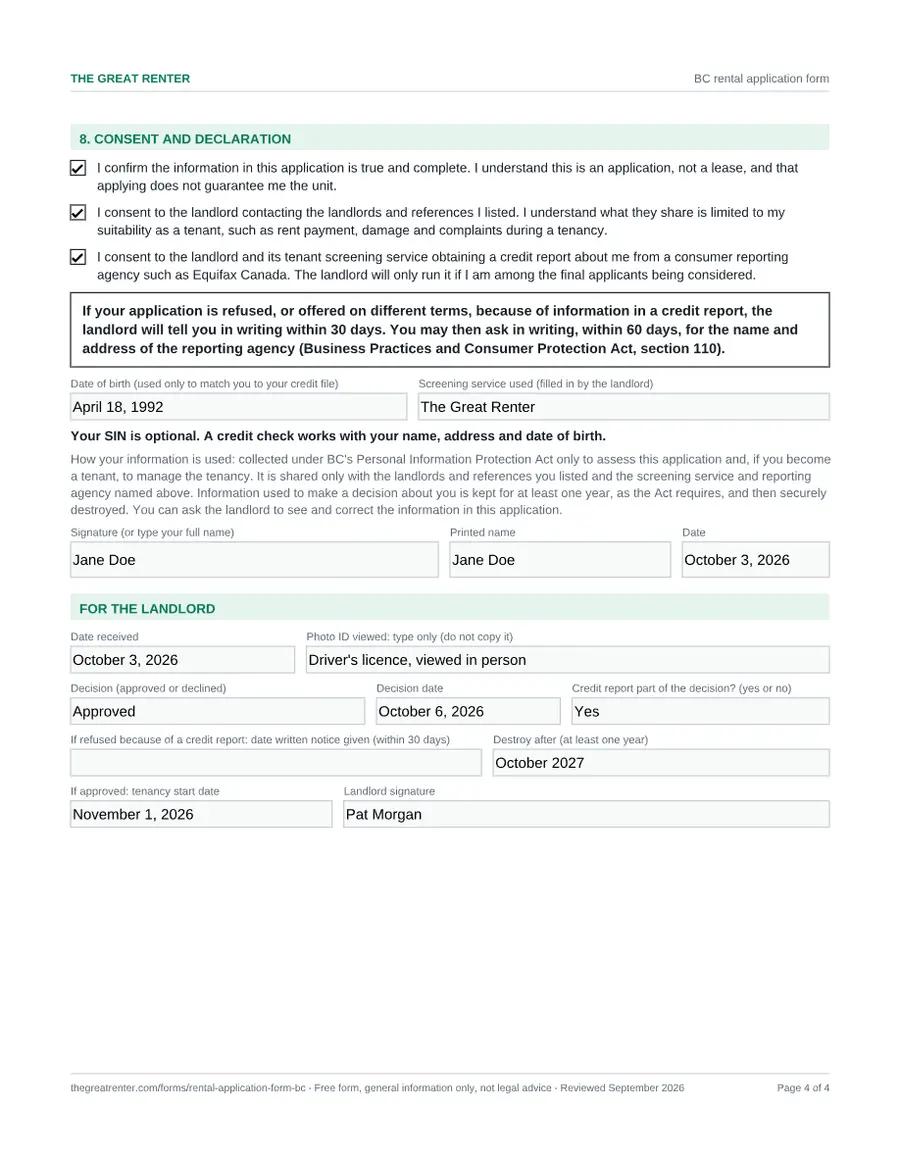
Consent to reference and credit checks, the refusal notice, date of birth for the credit check, and a signature.
Filled-in example
See every page, filled in
Sensitive questions
Sensitive questions: optional, or not asked
Social Insurance Number
OptionalThe commissioner says not to ask every applicant for a SIN, or to make it optional: a name and date of birth usually identify someone well enough for a credit check.3 This form makes it optional.
Social media profile
OptionalSocial media isn't an acceptable source for collecting an applicant's information without their consent.3 An optional line lets the applicant share a profile if they want to, which is their consent; don't go looking otherwise.
Bank or credit card details
Not askedKept off in BC. Banking information can't be required before the tenancy is established, and the province says landlords can't unreasonably ask for credit card or banking details, so even an optional question is a risk.3,6
ID number or a copy of ID
Not askedKept off in BC. Look at government photo ID and hand it back; the commissioner says not to copy it or record a licence or passport number.3,5,6
Never a reason to refuse an applicant in BC
- Indigenous identity
- Race
- Colour
- Ancestry
- Place of origin
- Religion
- Marital status
- Family status
- Physical or mental disability
- Sex
- Sexual orientation
- Gender identity or expression
- Age
- Lawful source of income
BC rules
Six rules to know before you choose a tenant
No application fees
Section 15 of the Residential Tenancy Act bars any fee for accepting or processing an application, investigating the applicant, or accepting them as a tenant.1,2
Deposits: half a month each
A security deposit and a pet damage deposit are each capped at half of one month's rent, and the security deposit can only be required when the tenancy agreement is made. Once a deposit is paid, the tenancy is established and you can't rent the unit to someone else.1,2
Credit checks at the end
Collect the consent on the application, but run the credit check only on your shortlist near the end of the process.3 The province also says the applicant's written approval is needed.6
Tell them in writing if a report decided it
If a credit report leads you to refuse an applicant, or offer different terms, give written notice within 30 days. They can then ask in writing, within 60 days, for the reporting agency's name and address.9
Reviewing an application
What to check, and what isn't a red flag
Worth a closer look
- A name, date of birth or address that doesn't match the photo ID you viewed.
- A current landlord you can't reach, or whose number you can't find anywhere but the application.
- Gaps in the rental history the applicant hasn't explained.
- Income figures that don't match the pay stub or the employer contact you called.
- Pressure to skip steps: signing today, moving in before checks, or paying in cash with no receipt.
Not a red flag
- A blank SIN: the privacy commissioner says to make it optional.3
- Where the income comes from: lawful source of income is a protected ground in BC tenancies.7,8
- A guide or service dog: it isn't a pet, can't be restricted, and needs no deposit.14
- Age from 19 up, or having children: both are protected, outside buildings reserved for people 55 and older.7,8
After it comes back
From application to signed agreement
- 1
Shortlist from the applications
Compare rental history, income and references first. Keep the credit check for the final few, as the commissioner recommends. Screen your finalists
The Great Renter sends each finalist a secure link to confirm their details and consent before anything runs. See what the credit report shows.- 3
Call previous landlords
Keep questions to suitability as a tenant: dates, rent, payment, damage and complaints.3 Our reference request template puts it in writing. - 4
- 5
Sign a written tenancy agreement
Use the RTB-1 tenancy agreement or your own with every standard term, then take the security deposit.10,1 - 6
Got an application back? Screen this applicant.
Send the applicant a secure link. They confirm their own details and consent, and you get their Equifax credit report and ID verification in one report. No account, no subscription.
See what the report looks likeGot questions?
BC rental applications, answered
Is a rental application binding in BC?
The application itself isn't a tenancy agreement. But once a deposit is paid, the tenancy is established and the landlord can't rent the unit to someone else, so don't take a deposit until you've made your decision.
Can I ask about pets on a BC rental application?
Yes. A BC tenancy agreement can ban pets or limit their size, kind or number, so asking up front is reasonable. Guide and service dogs aren't pets, can't be restricted, and need no pet deposit.
Is there a Word version of the BC rental application?
Yes. It comes as a fillable PDF and as a Word (.docx) file with the same wording. Use the Word version if you want to type in your unit details once and reuse it.
Is this BC rental application form free?
Yes. It's a free, fillable PDF you can use for any rental in British Columbia, with no sign-up. It's written to the BC privacy commissioner's guidance for landlords.
Can a BC landlord charge an application fee?
No. Section 15 of the Residential Tenancy Act says a landlord must not charge a fee for accepting or processing a rental application, investigating the applicant's suitability, or accepting them as a tenant.
Can I ask for a SIN on a rental application in BC?
Only as an optional question. The Office of the Information and Privacy Commissioner for BC says not to ask every applicant for a Social Insurance Number, or to make it optional, because a name and date of birth are usually enough for a credit check. This form marks it optional.
Can I photocopy an applicant's ID?
No. The commissioner's guidance is to view government photo ID and return it without copying or keeping it, and the province says landlords can't copy it. Don't write down a driver's licence or passport number either.
When should I run the credit check?
Near the end. The commissioner says consent can be collected on the application, but the credit check itself should only be run on the few applicants you're seriously considering.
How long do I keep applications from people I didn't rent to?
At least a year. BC's Personal Information Protection Act requires information used to make a decision about someone to be kept for a year, and the commissioner says that applies to unsuccessful applicants too. After that, destroy it securely.
Keep reading
- Tenant screening in BCThe Residential Tenancy Branch, consent, deposits and screening rules in one place.
- What a landlord can ask forBank statements, SIN, credit checks and deposits: what BC allows, next to four other provinces.
- Tenant credit check consent formA standalone consent with the section 110 notice, for checks outside the application.
- What a tenant background check coversID verification, watchlist and adverse media, and what they don't search.
Sources, checked September 2026
- 1.BC Residential Tenancy Act, SBC 2002, c. 78 (ss. 15, 18 to 20)
- 2.Government of BC, Tenancy deposits and fees
- 3.Office of the Information and Privacy Commissioner for BC, Private sector landlords and tenants (guidance, 2019)
- 4.BC Personal Information Protection Act, SBC 2003, c. 63 (s. 35)
- 5.OIPC BC, Investigation Report P18-01 (landlord application forms)
- 6.Government of BC, List and show a rental unit
- 7.BC Human Rights Code, RSBC 1996, c. 210 (s. 10)
- 8.BC Human Rights Tribunal, Tenancy
- 9.BC Business Practices and Consumer Protection Act, Part 6 (ss. 107, 108, 110)
- 10.Government of BC, Tenancy agreements
- 11.Government of BC, Residential tenancy forms (RTB-1 tenancy agreement)
- 12.Residential Tenancy Branch, Search past decisions
- 13.Residential Tenancy Branch, Published monetary orders
- 14.Government of BC, Pets and tenancy
- 15.Government of BC, Strata pet bylaws
This form and page are general information, not legal advice. Laws change; check the linked sources, and talk to a lawyer or your province's tenancy office about your situation.