
Free form · Ontario
Ontario rental application form, built for private landlords.
A four-page fillable PDF (and Word file) that asks what Ontario's human rights rules let a landlord ask, and nothing they don't. Use it instead of OREA Form 410 when you're renting out your own unit without a realtor.
Also in Word (.docx)See a filled-in example
Fillable PDF · 4 pages · No email or sign-up · Reviewed September 2026
 Filled-in example
Form 410
OREA Form 410, or this form?
What Form 410 is
Form 410, “Rental Application, Residential”, is one of the Ontario Real Estate Association's standard forms. OREA keeps its forms behind a member login and licenses them to real estate software providers.15 Its terms of use say the forms are for OREA members and certain licensees, and that any other use needs OREA's prior written consent.14
Which one to use
If a realtor is leasing your unit, they'll use Form 410 and you don't need anything here. If you're renting it out yourself, use a form you're free to use. This one is built line by line from what Ontario Regulation 290/98 lets a landlord request: rental history, credit references, consent to a credit check, and income information.1 Anything beyond that, like the SIN or bank details, is marked optional, and household ages aren't asked at all, for the reasons below.
Section by section
What's on the form, and why it's allowed
The rental
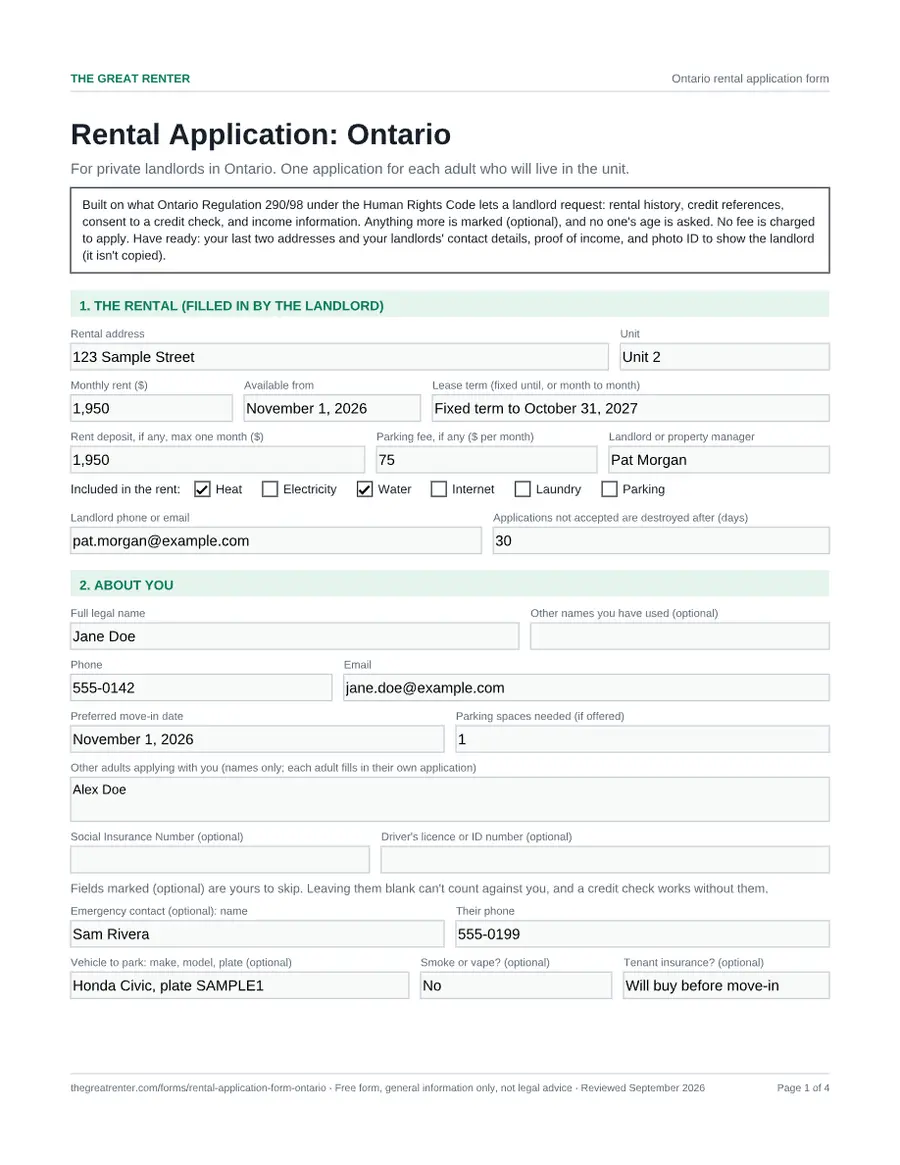
Your offer: address, rent, lease term, rent deposit, parking fee, what's included, your contact, and how long you keep applications.
Filled in before you hand the form out, so every applicant applies for the same unit on the same terms. The deposit line is capped at one month because a rent deposit is the only deposit Ontario allows.9About you
Name, contact details and other adult applicants, then optional SIN, licence number, emergency contact, vehicle, smoking, tenant insurance and pets.
Enough to identify the applicant and reach them, with the sensitive identifiers marked optional (see below). Each adult fills in their own copy. The form doesn't ask how many children will live there or anyone's age: the Ontario Human Rights Commission says asking applicants' ages on a form has been found to be discrimination based on family status.4Rental history
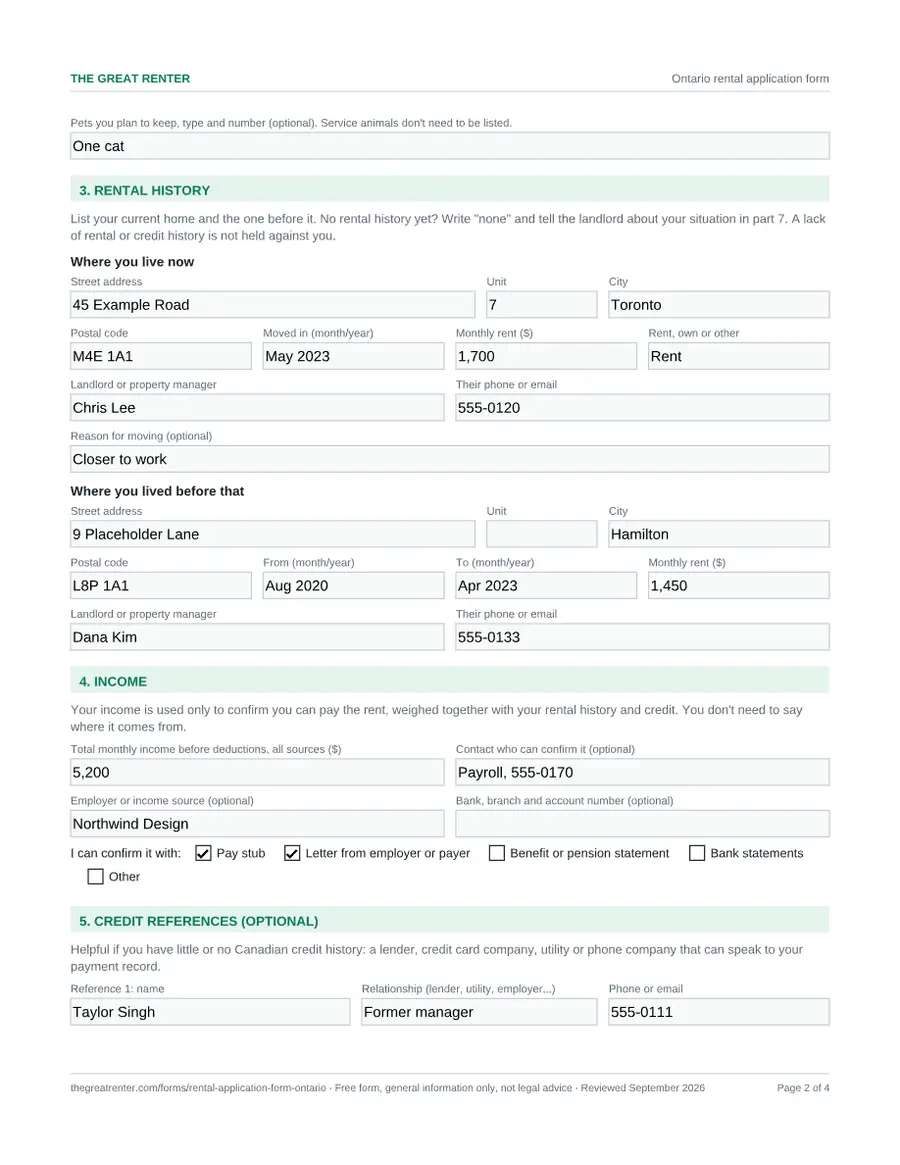
Current and previous address, dates, rent, and each landlord's name and contact.
Income
Total monthly income, how it can be confirmed, and optional employer and bank details.
Income information is allowed, but only alongside rental history, credit references or a credit check, and it has to be weighed together with them.1 Only the amount and proof are required: the Commission says landlords may confirm income exists but shouldn't judge its source, and that the regulation doesn't allow questions about employment history.4 So the employer line is optional, and there's no “how long have you worked there”.Credit references (optional)
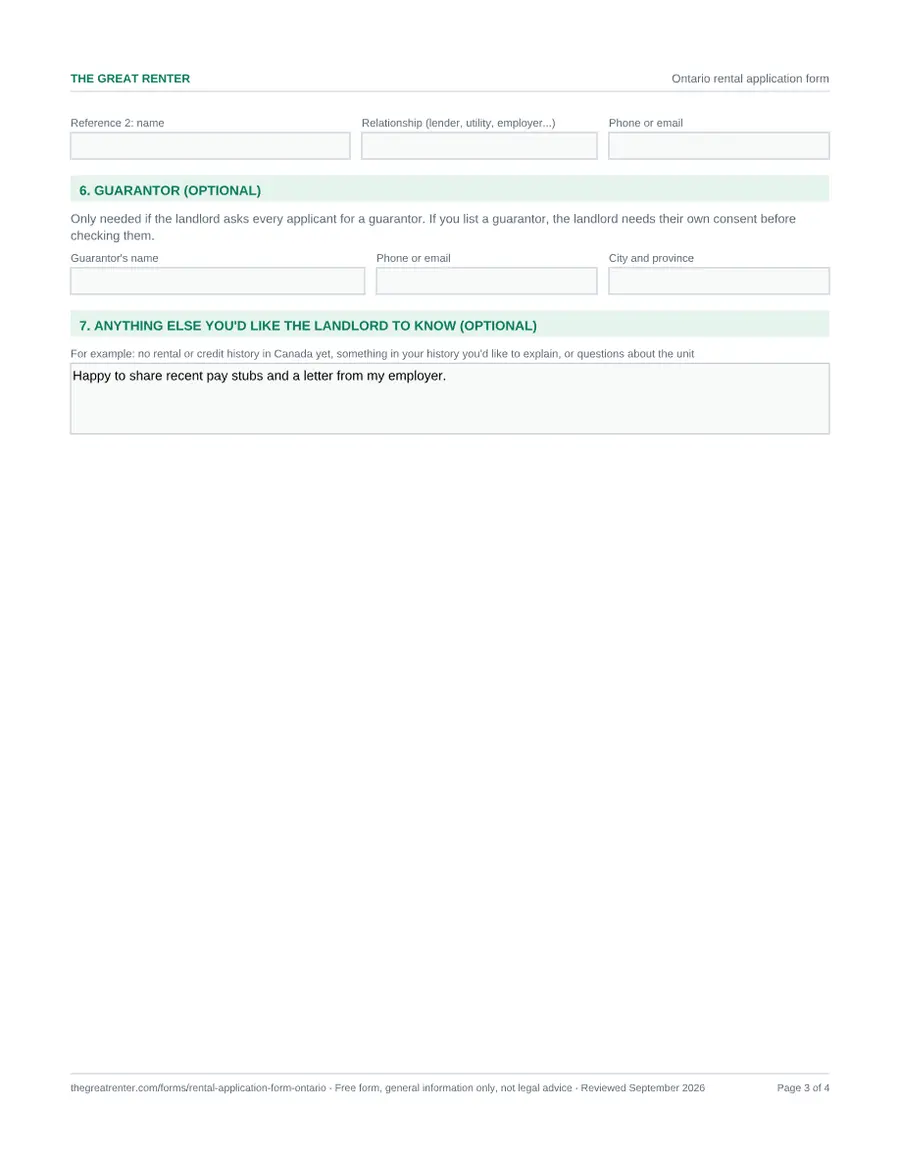
Up to two lenders, utilities or others who can speak to the applicant's payment record.
Credit references are also on the regulation's list.1 They give newcomers and people with thin credit files a way to show a payment record the credit bureau doesn't have.Guarantor (optional)
A guarantor's name and contact, only if the landlord asks every applicant for one.
Consent, notices and signature
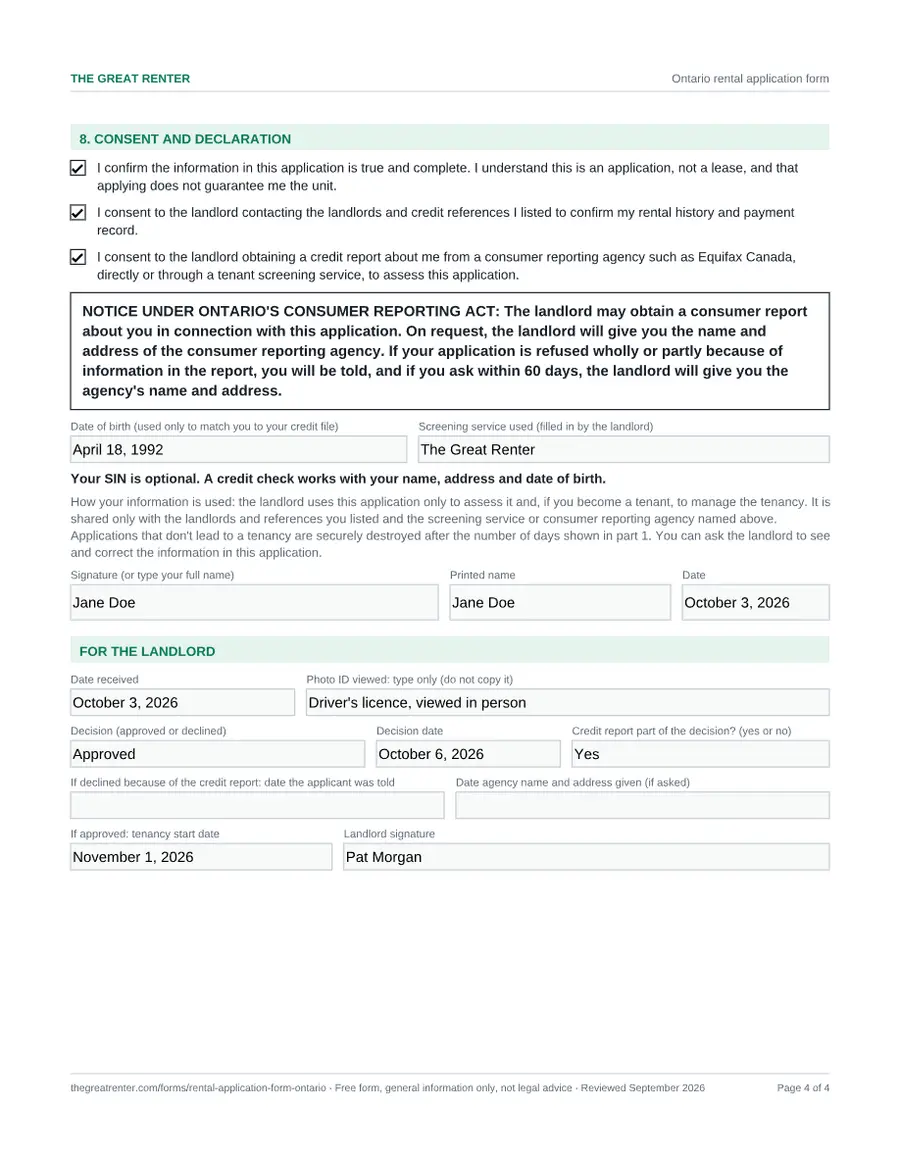
Consent to contact references and to a credit check, date of birth for the credit check only, and a signature.
A landlord needs the applicant's consent to share their details with a credit reporting agency, and the minimum for a credit check is name, address and date of birth.5 The Consumer Reporting Act notice is printed in bold 10-point type because section 10 requires that for its notices, and it tells the applicant they can ask which agency supplied the report if they're turned down.8
Filled-in example
See every page, filled in
Sensitive questions
Sensitive questions are optional, not required
Social Insurance Number
OptionalA landlord can't require a SIN, and a credit check doesn't need one.5 The Commissioner's tips say that if a form asks for it, it must be clearly marked optional, so this one does.6 Service Canada says applicants don't have to give a SIN on a rental application,7 and a SIN can reveal things like refugee status, so never hold a blank against anyone.4
Bank account details
OptionalA credit check doesn't use them. In one privacy commissioner case, a property manager resolved a complaint by making banking details, the SIN and the licence number optional on its form, the same approach this form takes.18
Licence or ID number
OptionalOptional, and still no photocopy: look at photo ID to confirm who you're dealing with, but the Commissioner says landlords likely don't need to keep a copy of a driver's licence.5,18
Employer
OptionalUseful for confirming income, but the regulation lets you ask about income, not a work history, and the Commission says “stable employment” requirements have been found discriminatory.1,4
Pets
OptionalA clause banning pets in an Ontario lease is void, so treat the answer as information, not a filter.9,19 If a condo corporation's rules restrict animals, the standard lease lets you require the tenant to follow them; say so in your listing.12
Ages, children or relationships
Not askedThe one thing kept off. The Commission says asking ages on the form has been found to be discrimination based on family status, and making the question optional doesn't change that. If you truly need an age (a seniors building, say), ask after you've approved the applicant.4
Never a reason to refuse an applicant in Ontario
- Race
- Ancestry
- Place of origin
- Colour
- Ethnic origin
- Citizenship
- Creed
- Sex
- Sexual orientation
- Gender identity
- Gender expression
- Age
- Marital status
- Family status
- Disability
- Receipt of public assistance
Ontario rules
Six rules that apply before the lease is signed
No application fee
The Residential Tenancies Act bars charging a prospective tenant any fee, premium, key deposit or similar charge unless a regulation allows it, and no regulation allows an application fee.9,10 Applicants can ask the Landlord and Tenant Board to get an illegal charge back.11
A rent deposit, and nothing else
The only deposit allowed is a rent deposit of no more than one month's rent, taken on or before signing, applied to the last month, and repaid if the tenant never moves in. You pay interest on it yearly.9 A refundable key or fob deposit up to its replacement cost is the one exception.10
Income can't be the only test
You can weigh income only together with rental history, credit references or a credit check, unless income is the only information you have.1 The Commission says rent-to-income cut-offs like 30% are not allowed outside rent-geared-to-income housing.3
A guarantor for everyone, or no one
You may require a guarantee for the rent.1 The Commission says to ask only if you require one from every tenant, or because of poor references, credit or a history of default, never because an applicant is a newcomer, young, a lone parent or on social assistance.4
The standard lease is required
Most Ontario tenancies that began on or after April 30, 2018 must use the government's Residential Tenancy Agreement (Standard Form of Lease).9,13 Your application form is separate: it never becomes part of the lease.
Say so if the credit report decided it
If you turn an applicant down wholly or partly because of their credit report, tell them when you give your decision; if they ask within 60 days, give them the agency's name and address.8 The form has a landlord-use box to record the date you did.
Reviewing an application
What to check, and what isn't a red flag
Worth a closer look
- A name, date of birth or address that doesn't match the photo ID you viewed.
- A current landlord you can't reach, or whose number you can't find anywhere but the application.
- Gaps in the rental history the applicant hasn't explained.
- Income figures that don't match the pay stub or the employer contact you called.
- Pressure to skip steps: signing today, moving in before checks, or paying in cash with no receipt.
Not a red flag
- No Canadian credit or rental history: the Commission says a lack of history shouldn't count against an applicant.3
- Income from social assistance or other benefits: receipt of public assistance is a protected ground in Ontario housing.2
- Income under three times the rent, on its own: fixed rent-to-income cut-offs aren't allowed outside rent-geared-to-income housing.3
- A blank SIN: applicants don't have to give one, and a credit check works without it.5,7
After it comes back
What to do once an application comes back
- 1
Check it's complete and signed
Every adult who will live there should have their own signed copy. An unsigned form is not consent. Screen your shortlist
Run the credit check the applicant consented to. With The Great Renter the applicant confirms their own details and consent in a secure link, so you never handle their date of birth. See what a tenant credit check shows.- 3
Call the landlords listed
Ask each one the same questions: dates, rent, whether it was paid on time, and whether proper notice was given. Our reference letter template includes a written request you can send instead. - 4
- 5
Decide the same way for everyone
Apply the same criteria to every applicant and keep a note of why you chose the person you did: the Commission says a landlord should be able to show how the successful applicant was chosen.4 - 6
Sign the standard lease
Use the Standard Form of Lease, collect only a rent deposit (and a key deposit if you like), and securely destroy the applications of everyone you didn't rent to.6,9
Got an application back? Screen this applicant.
Send the applicant a secure link. They confirm their own details and consent, and you get their Equifax credit report and ID verification in one report. No account, no subscription.
See what the report looks likeGot questions?
Ontario rental applications, answered
What documents can a landlord ask for with an Ontario rental application?
Ontario Regulation 290/98 lets a landlord ask for credit references, rental history, consent to a credit check, and income information, and weigh income only together with the others. Proof of income such as a pay stub or employer letter counts as income information. This form asks for those and marks everything else optional.
Can an Ontario landlord take a deposit with the rental application?
Only a rent deposit of no more than one month's rent, collected on or before the lease is signed and applied to the last month of the tenancy; it must be repaid if the tenant never moves in. A refundable key deposit is the only other amount allowed. Application fees and damage deposits are not.
Is there a Word version of this Ontario rental application?
Yes. The form comes as a fillable PDF and as a Word (.docx) file with the same wording. Use the Word version if you want to type in your unit details once and reuse it.
Is this Ontario rental application form free to use?
Yes. Download it, fill it in on screen or print it, and use it as often as you like. There's no email or sign-up. It's written for private landlords renting their own units in Ontario.
Can a private landlord use OREA Form 410?
OREA's terms of use say its standard forms, including Form 410 (Rental Application, Residential), are for OREA members and certain licensees, and any other use needs OREA's prior written consent. If a realtor is handling your rental they will use it; if you're renting on your own, use a form you're free to use, like this one.
Can I ask for a Social Insurance Number on a rental application in Ontario?
You can't require it. The Privacy Commissioner of Canada says a landlord doesn't need a SIN for a credit check, which needs only a name, address and date of birth, and Service Canada says you don't need to give a SIN to fill in a rental application. The Commissioner's tips add that if a form asks for one, it must be clearly marked optional, which is how this form asks.
Can I charge an application fee in Ontario?
No. The Residential Tenancies Act bars charging a prospective tenant any fee or similar charge unless a regulation allows it, and the regulation's list of allowed charges doesn't include application or screening fees. A refundable key deposit is allowed; an application fee is not.
Can I require an income of three times the rent?
Not as a hard cut-off. Under Ontario Regulation 290/98 you can consider income only together with rental history, credit references or a credit check, and the Ontario Human Rights Commission says fixed rent-to-income ratios such as 30% are not allowed outside rent-geared-to-income housing.
What should I do with applications from people I don't rent to?
Keep them only as long as you need to, then destroy them securely. The Privacy Commissioner advises landlords not to keep personal information indefinitely. The form has a blank for you to state how long you keep unsuccessful applications, so applicants know up front.
Keep reading
- Tenant screening in OntarioThe Landlord and Tenant Board, deposits, rent increases and screening limits in one place.
- What a landlord can ask forBank statements, SIN, credit checks and deposits: what Ontario allows, next to four other provinces.
- Tenant credit check consent formA standalone consent, if you'd rather collect it separately from the application.
- What a tenant credit check showsThe four parts of an Equifax report and how to read them.
Sources, checked September 2026
- 1.Ontario Regulation 290/98, Business practices permissible to landlords in selecting prospective tenants
- 2.Ontario Human Rights Code, R.S.O. 1990, c. H.19
- 3.Ontario Human Rights Commission, Policy on human rights and rental housing
- 4.Ontario Human Rights Commission, Identifying discrimination in rental housing (policy, part IV)
- 5.Office of the Privacy Commissioner of Canada, Privacy in the landlord and tenant relationship
- 6.Office of the Privacy Commissioner of Canada, 10 privacy tips for the rental housing sector
- 7.Service Canada, The Social Insurance Number Code of Practice
- 8.Ontario Consumer Reporting Act, R.S.O. 1990, c. C.33 (s. 10)
- 9.Ontario Residential Tenancies Act, 2006 (ss. 12.1, 14, 105 to 107, 134)
- 10.Ontario Regulation 516/06 under the Residential Tenancies Act (s. 17, key deposits)
- 11.Landlord and Tenant Board, Form T1 instructions (illegal charges)
- 12.Government of Ontario, Guide to Ontario's standard lease
- 13.Central Forms Repository, Residential Tenancy Agreement (Standard Form of Lease)
- 14.OREA, Standard Forms terms of use
- 15.OREA, Standard Forms and Clauses
- 16.Landlord and Tenant Board, Law, rules and decisions
- 17.Ontario Data Catalogue, Landlord and Tenant Board order catalogue
- 18.Office of the Privacy Commissioner of Canada, Early resolved case summary 2013-01 (optional SIN, licence and banking details)
- 19.Government of Ontario, Renting in Ontario: your rights
This form and page are general information, not legal advice. Laws change; check the linked sources, and talk to a lawyer or your province's tenancy office about your situation.