
Free form · Any province
Tenant credit check consent form, on one page.
A one-page fillable PDF that gets an applicant's written consent to a credit check, with the notices Ontario, BC and Manitoba add to the federal rules printed in the size they require.
Screening with The Great Renter? The applicant gives consent in our secure link, so this form is optional: keep it as a paper record.
Also in Word (.docx)See a filled-in example
Fillable PDF · 1 page · No email or sign-up · Reviewed September 2026
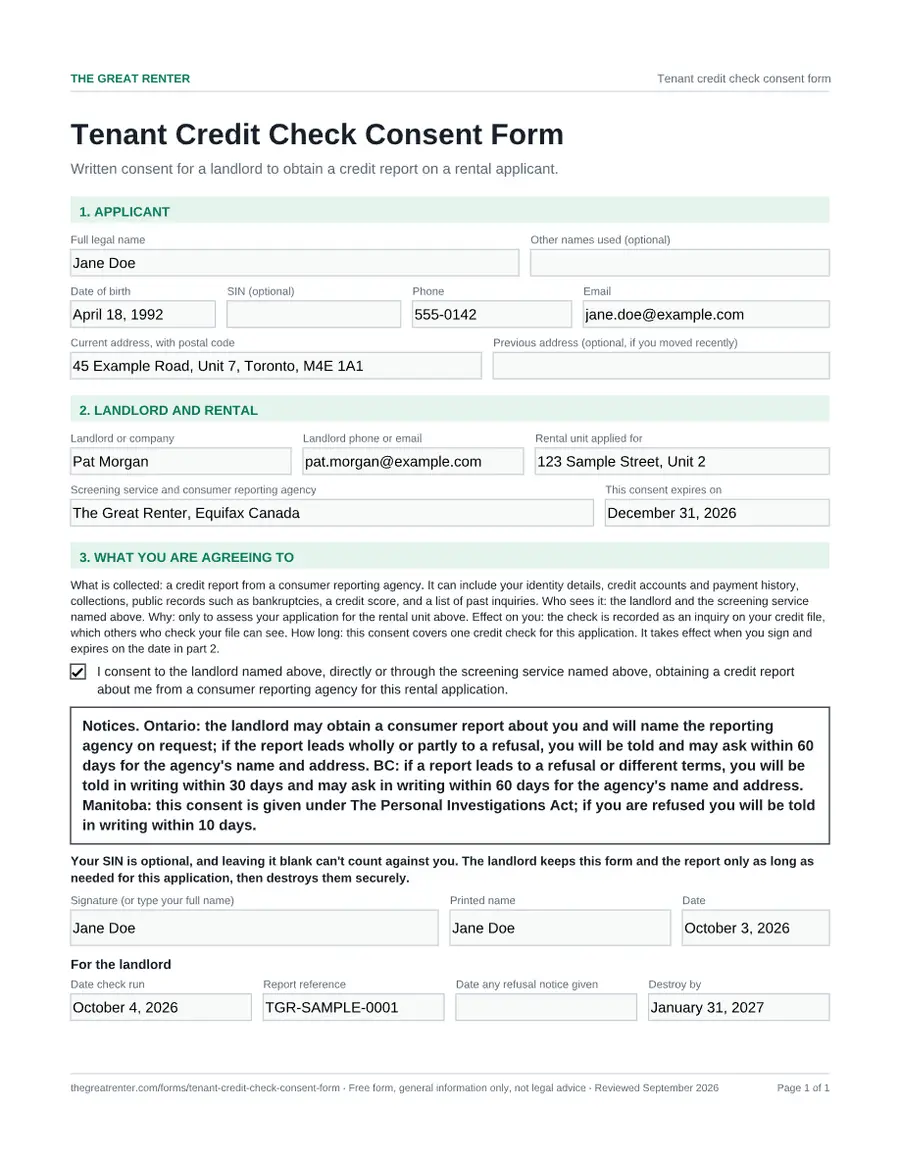 Filled-in example
Section by section
What each part of the form does
Applicant
Legal name, other names, date of birth, an optional SIN, phone, email, current and previous address.
Landlord and rental
Who is asking, for which unit, through which screening service, and until when.
What you're agreeing to
A plain statement of what's collected, who sees it, why, the effect on the applicant, and how long consent lasts.
The Privacy Commissioner's consent guidelines ask organizations to make four things clear: what information, who it's shared with, for what purpose, and any risk of harm. Financial information is generally sensitive, which calls for express consent.1 In Manitoba the consent must also give its effective date and when it expires.9Provincial notices
Ontario, BC and Manitoba notices in one bold box, so one form works anywhere.
Signature and landlord record
Signature and date, then your record of when the check ran, any refusal notice, and a destroy-by date.
The record keeps the notice deadlines in front of you, and the destroy-by date follows the Commissioner's advice not to keep personal information indefinitely.3
Filled-in example
See every page, filled in
By province
Credit check consent rules across Canada
Everywhere: PIPEDA
A landlord needs consent to share an applicant's information with a credit reporting agency, and should get express agreement before a credit check.2 Provincial rules add to this.
Ontario
Tenancy is a permitted purpose for a consumer report. If you refuse someone wholly or partly because of it, tell them when you give your decision, and name the agency if they ask within 60 days.4
British Columbia
Consent is required and can be clear, prominent wording in the application. If a report leads to a refusal, give written notice within 30 days.5 Run the check only on your shortlist.6
Alberta
Consent is required under both the Consumer Protection Act and PIPA. The applicant can instead give you their own report.7
Manitoba
A credit check is a personal investigation that needs consent first, worded as the regulation requires. Refusals get written notice within 10 days.8,9
Quebec
The Commission d'accès à l'information says you need the future tenant's consent before a credit check, and that a name, address and date of birth are enough to run it.10
Soft or hard?
What to tell an applicant about their score
It appears as an inquiry
Equifax lists landlords among those who may access a report, and everyone who receives one is recorded under inquiries on the file.11
Providers say no score effect
Certn describes its credit check as a soft inquiry that doesn't affect the score.14 Equifax says only inquiries tied to actively seeking credit may.12
The regulator hedges
The Financial Consumer Agency of Canada lists “some rental applications” as an example of a hard inquiry.13 So the form says the check is recorded as an inquiry, and leaves it there.
After it comes back
Using the form
- 1
Hand it out with the application
Or collect it once you have a shortlist. In BC the privacy commissioner says to run the check itself only on the few applicants you're seriously considering.6 Run the check
If you screen through The Great Renter, the applicant confirms their details and gives consent inside the secure link, so this form becomes your paper record. See what the credit report shows.- 3
- 4
Destroy it on the date you wrote down
Shred the form and delete the report once you no longer need them.3
Skip the paperwork on the check itself.
Pay once and send the applicant a secure link. They confirm their details and consent before anything runs, and you get their Equifax credit report and ID verification in one report.
See what the report looks likeGot questions?
Credit check consent, answered
Can a landlord run a credit check without the tenant's consent?
No. The Privacy Commissioner of Canada says a landlord needs the applicant's consent to share their information with a credit reporting agency, and provinces add their own rules: BC and Alberta require consent to obtain the report, Manitoba requires consent before any personal investigation, and Ontario's Consumer Reporting Act adds notice duties.
Do I need written consent to run a tenant credit check?
You need the applicant's consent everywhere in Canada, and the Privacy Commissioner says landlords should get express agreement before a credit check. Written consent is the easiest to prove. Ontario's notices must be in writing, BC accepts clear wording in the application, and Manitoba's regulation sets out how a written consent must look.
Can the consent be part of the rental application?
Yes. BC's consumer protection law accepts clear, prominent consent wording in a tenancy application, and Manitoba's Personal Investigations Act lets the consent sit in the application. Each of our provincial rental application forms includes one. Use this standalone form when your application doesn't.
Will a tenant credit check hurt the applicant's credit score?
It will show as an inquiry on their credit file. Certn, the provider behind our reports, says its tenancy credit check doesn't affect the score, and Equifax says only inquiries tied to seeking credit may. But the Financial Consumer Agency of Canada lists some rental applications among hard inquiries, so tell applicants it will appear as an inquiry rather than promising no effect.
Does the applicant have to give their SIN?
No. The Privacy Commissioner says a landlord doesn't need a Social Insurance Number for a credit check, which needs a name, address and date of birth, and Equifax describes giving a SIN as optional. This form has an optional SIN line the applicant can leave blank.
Do I need this form if I screen with The Great Renter?
Not to run the check. The applicant confirms their own details and gives consent inside our secure link before anything runs. The form is useful if you want a signed paper record, run checks another way, or your application form has no consent wording.
Is there a Word version of the consent form?
Yes. It comes as a fillable PDF and as a Word (.docx) file with the same wording, including the provincial notices.
Keep reading
- What a tenant credit check showsThe four parts of an Equifax report, score bands, and common misreads.
- What a landlord can ask forWhat else an application can ask for, from the SIN to bank statements, in five provinces.
- Ontario rental application formConsent and the Consumer Reporting Act notice built into the application.
- See a sample screening reportWhat you get back once the applicant has consented.
Sources, checked September 2026
- 1.Office of the Privacy Commissioner of Canada, Guidelines for obtaining meaningful consent
- 2.Office of the Privacy Commissioner of Canada, Privacy in the landlord and tenant relationship
- 3.Office of the Privacy Commissioner of Canada, 10 privacy tips for the rental housing sector
- 4.Ontario Consumer Reporting Act, R.S.O. 1990, c. C.33 (ss. 8 and 10)
- 5.BC Business Practices and Consumer Protection Act, Part 6 (ss. 107, 108, 110)
- 6.Office of the Information and Privacy Commissioner for BC, Private sector landlords and tenants
- 7.Office of the Information and Privacy Commissioner of Alberta, Guidance for landlords and tenants
- 8.Manitoba, The Personal Investigations Act, C.C.S.M. c. P34
- 9.Manitoba, Personal Investigations Regulation, Man. Reg. 392/87 R
- 10.Commission d'acces a l'information du Quebec, Signing a lease
- 11.Equifax Canada, Who can access your credit report
- 12.Equifax Canada, How are credit scores calculated
- 13.Financial Consumer Agency of Canada, Improving your credit score
- 14.Certn, Credit checks
- 15.Equifax Canada, How to get a credit report for free (SIN optional)
This form and page are general information, not legal advice. Laws change; check the linked sources, and talk to a lawyer or your province's tenancy office about your situation.