
Free form · Any province outside Quebec
Rental guarantor form, with the agreement.
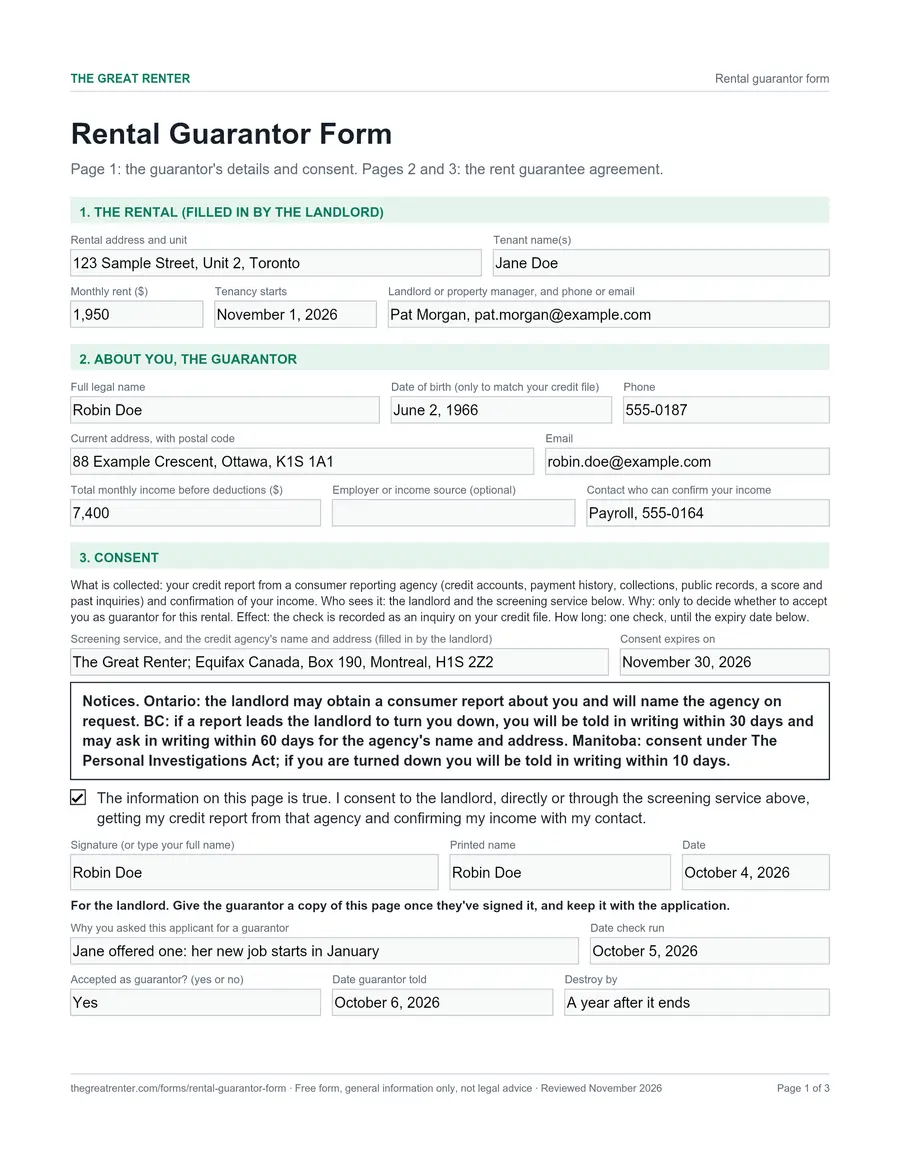
Page 1 is the guarantor's own application and consent to a credit check. Pages 2 and 3 are a rent guarantee agreement for the landlord, tenant and guarantor to sign with the lease, with a limit, an end date and a copy for everyone.
Also in Word (.docx)See a filled-in example
- Fillable PDF
- 3 pages
- No email or sign-up
- Reviewed November 2026
The Great Renter is the official
screening partner of
 Filled-in example
- Proudly Canadian
- Powered by Certn
- Official Equifax data
- Bank-level security
- PIPEDA compliant
Section by section
What each part of the form does
Page 1: the rental and the guarantor
The rental and tenant, then the guarantor's name, date of birth, address, phone, email and income.
A credit check needs a name, address and date of birth.1 The page doesn't ask for a SIN, the guarantor's relationship to the tenant or how long they've lived at their address. Quebec's privacy regulator has gone further, limiting what one landlord could collect about guarantors to identity and ability to pay,3 which is one reason this form isn't for use in Quebec.Page 1: consent and notices
What's collected and why, the Ontario, BC and Manitoba notices in 10-point bold, and the guarantor's signature.
The guarantor is checked as a person in their own right, so they give their own consent, covering what's collected, who sees it, why, and the effect on them.1,2 Ontario's Consumer Reporting Act wants its notices bold or underlined and at least 10 points,4 and Manitoba's Personal Investigations Act wants a written consent of at least 10 points above the signature.5,6 Whether either applies to a guarantor isn't settled, so the form follows both. Manitoba's tenancy branch also says to get a guarantor's written consent before confirming their information.16Page 1: the landlord's record
Why you asked this applicant for a guarantor, when you ran the check, your decision and a destroy-by date.
Pages 2 and 3: the guarantee
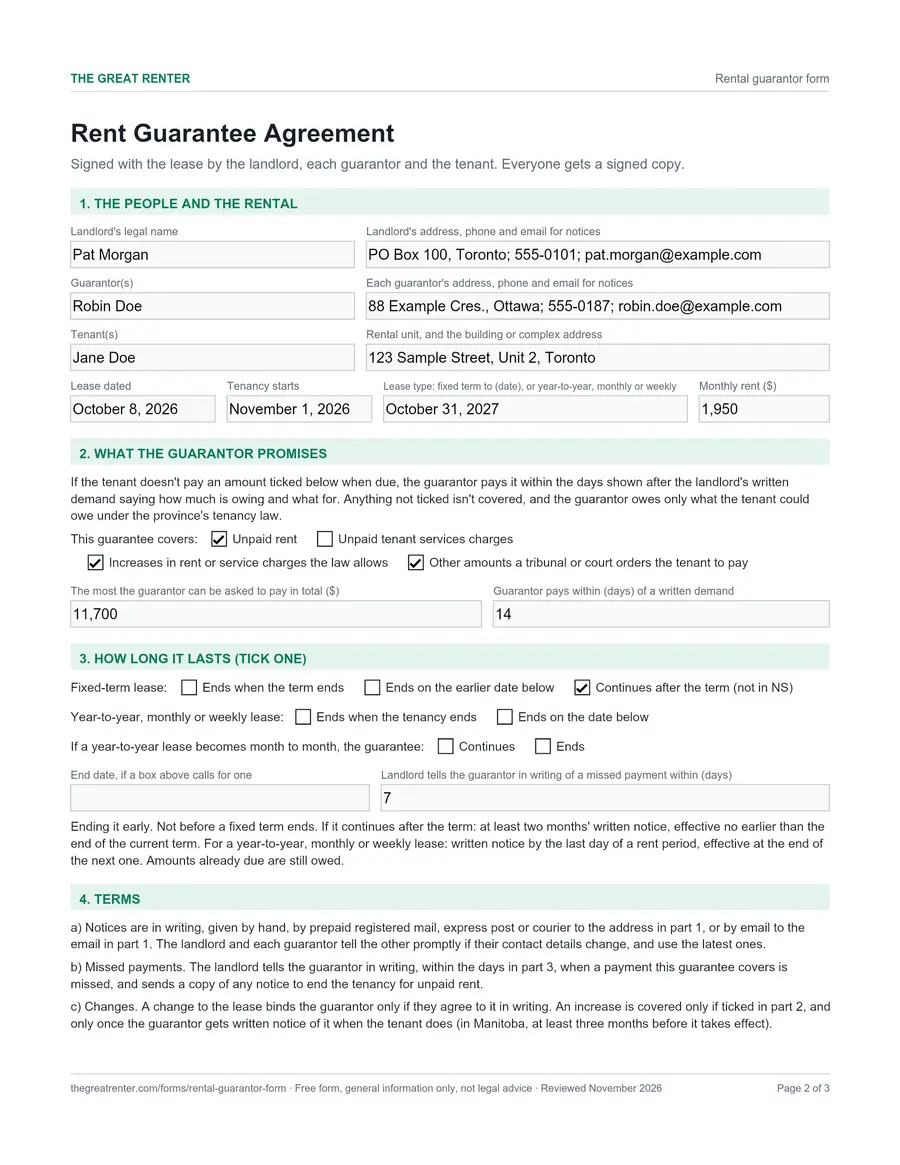
Who's who, what the guarantor covers, a dollar limit, how long it lasts, how the guarantor can end it, and the notice periods.
Manitoba and Nova Scotia list what a guarantee agreement must set out: contact details for notices, the obligations covered, the extent of the guarantor's liability, how long it lasts and whether it continues on renewal, the notice period for unpaid rent, and whether the guarantor can end it.14,17 Manitoba's branch says the maximum amount must be stated,15 so the form asks for a dollar limit.Part 4: the terms
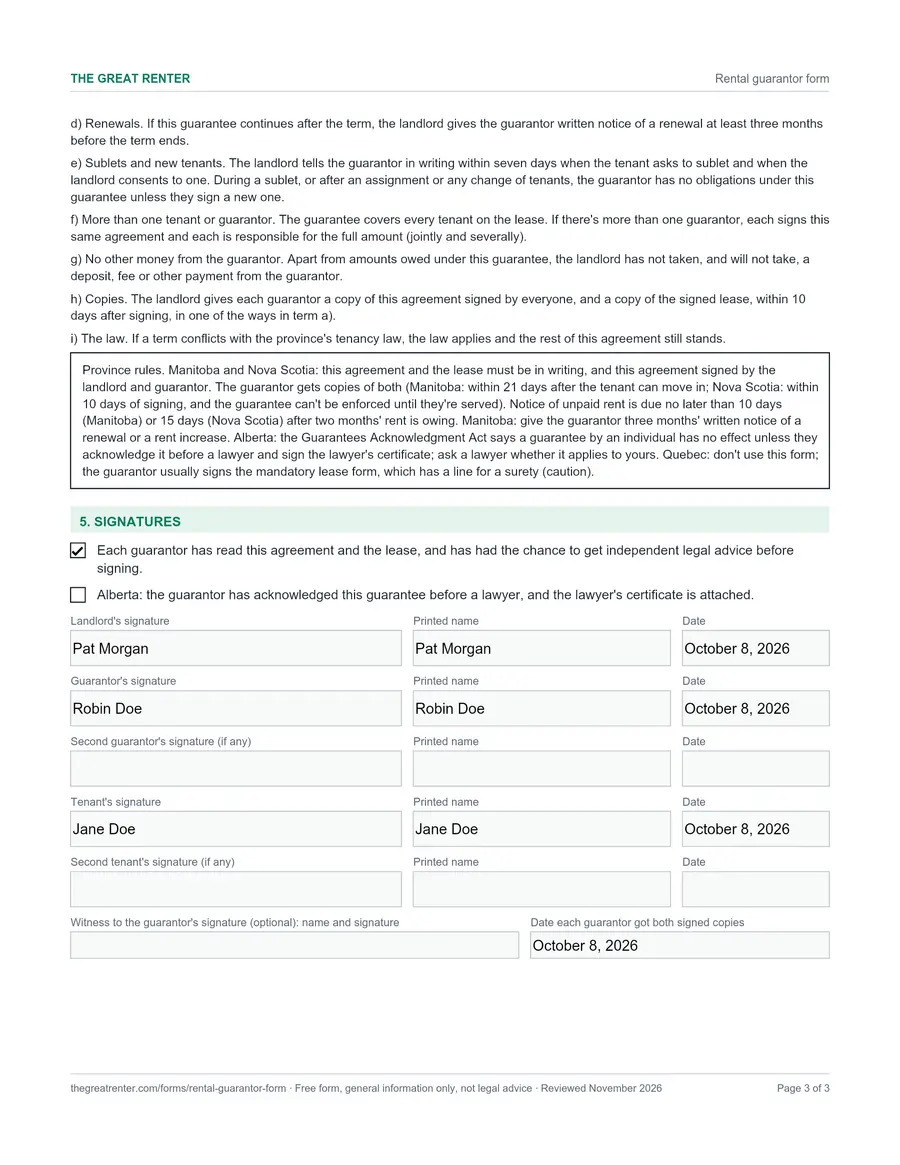
Notices, missed payments, changes, renewals, sublets, several tenants or guarantors, no money from the guarantor, copies, and the law.
Each term follows the Manitoba and Nova Scotia rules, so one form works in both: the guarantor hears about unpaid rent, renewals, rent increases and sublets in writing; during a sublet or after a change of tenants they owe nothing without a new guarantee; notices go by the methods Nova Scotia allows; and apart from the guarantee itself, no money is taken from the guarantor, as Manitoba requires.14,15,17 Elsewhere they're ordinary contract terms that protect both sides.Part 5: signatures
The landlord, each guarantor and each tenant sign; an Alberta lawyer's certificate box; the date copies were given.
In Ontario a guarantee has to be in writing and signed by the guarantor before you can sue on it, and BC asks for the same unless the guarantor's own conduct shows the guarantee.13,21 Alberta's Guarantees Acknowledgment Act says an individual's guarantee has no effect without a lawyer's certificate; ask a lawyer whether it covers yours.19 In Nova Scotia it can't be enforced until the signed copies have been served, so record the date.17
Filled-in example
See every page, filled in
By province
Guarantor rules across Canada
Ontario
You may require a guarantee for the rent.7 The Human Rights Commission says to ask only if you have the same requirements for all tenants.9 Its policy adds that a co-signer may be appropriate for poor references, poor credit or a history of default, but not simply because of a protected ground, and not with an income ratio you couldn't apply to the tenant.8 The Landlord and Tenant Board won't order a guarantor to pay, so you claim in court: Small Claims Court hears claims up to $50,000.11,12
Manitoba
Ask only when you have a valid reason about a particular applicant. The agreement must be written and signed, set out what the Act lists, and reach the guarantor with the lease within 21 days after the tenant can move in. Take no other payment from the guarantor. The Residential Tenancies Branch hears guarantee claims.14,15
Nova Scotia
You can ask for a guarantor based on the tenant's finances.18 The agreement must be written, signed and set out what the Act lists, and needs a written lease. Serve the guarantor both signed documents within 10 days: until then, the guarantee can't be enforced. Claims go to the Director within a year after the lease ends.17
Alberta
The Guarantees Acknowledgment Act says a guarantee by an individual has no effect unless they acknowledge it before a lawyer and sign the lawyer's certificate, which can be done by video call.19 Rent guarantees aren't among its listed exceptions, but no official source says whether it covers them, so ask a lawyer, and attach any certificate to page 3.
After it comes back
Using the form
Screen the guarantor
Have them fill in and sign page 1, then check their credit and income the way you would a tenant's. The check shows as an inquiry on their credit file.25 Someone who has never lived in Canada won't have a Canadian credit file, and in Quebec a tenant must offer a surety who lives in Canada unless you chose that person.22 See how to screen a guarantor.Sign the guarantee with the lease
Fill in pages 2 and 3, including a dollar limit, and sign them when the lease is signed. In Alberta, ask a lawyer whether the guarantor also needs to acknowledge it before them.19
Check the guarantor the way you check the tenant.
Send the guarantor their own secure link. They confirm their details and consent before anything runs, and you get their Equifax credit report and ID verification in one report.
Got questions?
Guarantors, answered
What is a rental guarantor form?
It's the paperwork for a guarantor: someone who agrees to pay what the tenant owes if the tenant doesn't. Ours has two parts: the guarantor's own application and consent to a credit check, and a rent guarantee agreement that the landlord, guarantor and tenant sign with the lease.
Is a guarantor letter enough?
Often not. Manitoba and Nova Scotia require a written agreement signed by the landlord and the guarantor that sets out specific terms, and Alberta's guarantee law calls for a lawyer's certificate on an individual's guarantee. A short letter also rarely says how much the guarantor owes or for how long.
Is there an official guarantee form in Manitoba or Nova Scotia?
No. Both Acts allow one to be prescribed, but as of November 2026 neither province has one, so landlords write their own agreement that meets the Act. This form covers each item both Acts list.
Can I use this form in Quebec?
No. In Quebec the guarantor usually signs the mandatory lease form itself, which has a line for a surety (caution), and what a landlord collects about them is limited to their identity and their ability to pay.
Can I charge the guarantor a fee or take a deposit from them?
Don't. Manitoba bars taking any payment from a guarantor that the Act doesn't allow, and elsewhere money taken on a tenant's behalf may count toward the province's deposit limit. The agreement states that, apart from amounts owed under the guarantee, no money is taken from the guarantor.
What if the tenant stops paying?
Tell the guarantor in writing as the agreement says, then send a written demand. In Ontario the Landlord and Tenant Board won't order a guarantor to pay, so the claim goes to court; Small Claims Court hears claims up to $50,000. In Manitoba and Nova Scotia the residential tenancies office hears guarantee claims; in Nova Scotia, apply within a year after the lease ends.
Is the form available in Word?
Yes. It comes as a fillable PDF and as a Word (.docx) file with the same wording.
Keep reading
- A landlord's guide to guarantorsWhen you can ask for one, how to screen them, and what to do if the rent stops.
- Tenant credit check consent formThe same consent on its own page, for the tenant.
- What a tenant credit check showsThe four parts of an Equifax report, score bands, and common misreads.
- See a sample screening reportWhat you get back once the guarantor has consented.
Sources, checked November 2026 (25)
- 1Office of the Privacy Commissioner of Canada, Privacy in the landlord and tenant relationship
- 2Office of the Privacy Commissioner of Canada, Guidelines for obtaining meaningful consent
- 3Commission d'accès à l'information du Québec, decision 10 04 75 (2013, information about a guarantor)
- 4Ontario Consumer Reporting Act, R.S.O. 1990, c. C.33 (s. 10)
- 5Manitoba, The Personal Investigations Act, C.C.S.M. c. P34
- 6Manitoba, Personal Investigations Regulation, Man. Reg. 392/87 R (ss. 7, 9)
- 7Ontario Regulation 290/98, Business practices permissible to landlords in selecting prospective tenants (s. 2)
- 8Ontario Human Rights Commission, Policy on human rights and rental housing (s. 4.2.6, Guarantors)
- 9Ontario Human Rights Commission, Human rights in housing: an overview for landlords
- 10Ontario Human Rights Commission, Identifying discrimination in rental housing (policy, part V)
- 11Landlord and Tenant Board, Interpretation Guideline 11: Rent Arrears
- 12Government of Ontario, Suing someone in Small Claims Court
- 13Ontario Statute of Frauds, R.S.O. 1990, c. S.19 (s. 4)
- 14Manitoba Residential Tenancies Act, C.C.S.M. c. R119 (ss. 7(1.1), 28.1 to 28.15, 152)
- 15Manitoba Residential Tenancies Branch, Guarantee Agreements: Information for Landlords (fact sheet, December 2019)
- 16Manitoba Residential Tenancies Branch, Guideline 2.2: Co-signers and guarantors
- 17Nova Scotia Residential Tenancies Act (ss. 8A to 8M, 13, 17A)
- 18Government of Nova Scotia, Residential tenancies: a guide to renting
- 19Alberta Guarantees Acknowledgment Act, RSA 2000, c. G-11 (ss. 3, 3.1, 4)
- 20BC Residential Tenancy Branch, Policy Guideline 27: Jurisdiction (co-signers and guarantors)
- 21BC Law and Equity Act, RSBC 1996, c. 253 (s. 59)
- 22Civil Code of Québec (arts. 1881, 1904, 2333, 2335, 2337)
- 23Regulation respecting mandatory lease forms, CQLR c. T-15.01, r. 3 (the lease form, section H)
- 24Commission des droits de la personne et des droits de la jeunesse, Aide-mémoire: propriétaires d'immeubles à logements
- 25Equifax Canada, Who can access your credit report
This form and page are general information, not legal advice. Laws change; check the linked sources, and talk to a lawyer or your province's tenancy office about your situation.